
A mobile home installed for over twenty years on a camping plot is often a fully paid asset, still habitable, but the manager announces that it must leave the location. This situation affects a growing number of owners faced with contractual clauses that set an administrative lifespan much shorter than the actual lifespan of the vehicle.
Age limit clause in the plot contract: the most common trap
Most rental contracts for plots include a clause requiring the replacement or removal of the mobile home after a specified period, often set between ten and fifteen years. This limit has no legal basis related to safety or the actual obsolescence of the asset. It is based on the commercial image criteria of the campsite.
In practice, a manager can require the departure of a mobile home over twenty years old by invoking this clause, even if the structure is in good condition. The owner then faces a binary choice: buy a newer model (often from a partner dealer of the campsite) or leave the location.
Understanding the rights of mobile home owners regarding these clauses helps assess whether they constitute an abusive practice or a valid contractual framework.
The age clause does not equate to a legal obligation for replacement. Several owners have challenged these provisions in court, arguing that the imposed depreciation does not correspond to any technical standard. The issue has been raised several times in Parliament, notably by deputies and senators pointing out the asymmetry between managers and owners, without any specific protective measure being adopted to date.

Legal status of mobile homes over 20 years old: vehicle, not construction
Decree No. 2007-18 of January 5, 2007 classifies the mobile home as a habitable terrestrial vehicle intended for temporary or seasonal occupation. This classification has direct consequences on the rights of the owner of an older model.
Maintained mobility and absence of building permit
A mobile home must retain its wheels and towing bar. As long as this mobility capacity exists, no building permit is required for its installation in a campsite. A model over twenty years old remains subject to the same rules as a new model in this regard.
However, if the owner has removed the wheels or permanently anchored the structure to the ground, the mobile home may be reclassified as a construction, which radically changes the applicable legal framework and may lead to urban planning obligations.
Plot rental contract and renewal
The contract binding the owner to the campsite manager is a plot rental contract, not a residential lease. The manager is not obliged to renew this contract upon expiration. This lack of rental protection makes owners of older mobile homes particularly vulnerable.
When the contract expires, the manager can refuse renewal without any particular reason or condition the renewal to the replacement of the mobile home. No right to remain on the plot exists under the current state of the law.
VAT regularization and LMNP status: the tax risk after 20 years
Owners who acquired their mobile home through an LMNP (non-professional furnished rental) para-hotel arrangement with VAT recovery need to be aware of a mechanism that is rarely explained. The VAT recovery regularization period lasts for twenty years.
- If the mobile home has exceeded this period and the rental activity has been maintained, the VAT recovered at purchase is definitively acquired. The owner does not have to return anything to the Treasury.
- If resale or cessation of activity occurs before the end of the twenty years, a portion of the VAT must be refunded, proportionally to the remaining years.
- For a mobile home over twenty years old still in operation, this tax risk is extinguished, which constitutes a concrete advantage compared to a more recent asset.
Checking the start date of LMNP activity before any resale avoids an unpleasant tax surprise. Returns vary on this point depending on individual situations, but the calculation principle remains the same.
Resale and insurance of an old mobile home: concrete obstacles
Beyond the plot contract, a mobile home over twenty years old faces practical difficulties that reduce its market value and the options available to its owner.
Financing and banking perception
Some credit institutions no longer consider the mobile home as a valuable asset beyond twenty years. Financing through credit or pledging the asset becomes difficult, if not impossible. A potential buyer who needs financing will turn to a newer model.
Reduced insurance coverage
Insurers apply depreciation coefficients that significantly lower the insured value of an old mobile home. Finding suitable coverage remains possible, but the guarantees offered are often limited to basic risks. Comparing several quotes from specialized insurance before renewing a contract on an older model helps avoid under-coverage.
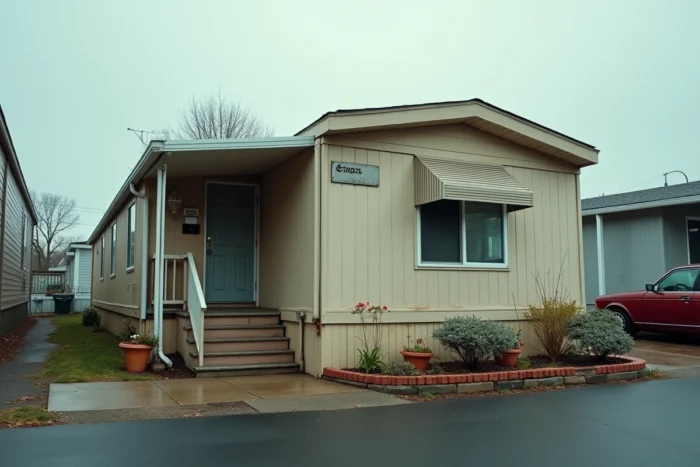
Compliance with standards and recycling of materials: what the regulations say
A mobile home over twenty years old was manufactured according to standards that have evolved since. The NF S 56-410 standard governs the design of mobile leisure residences. An older model is not automatically non-compliant, but certain elements may pose problems.
- Electrical and gas installations must comply with the standards in force at the time of their commissioning, but periodic checks are still recommended.
- Insulation and structural materials may contain components whose regulations have changed since manufacturing.
- In the event of permanent removal, the issue of material recycling arises: the owner is responsible for the disposal and deconstruction of their asset.
The compliance of an old mobile home is not limited to its visual condition. A technical diagnosis before any transaction protects both buyer and seller.
The current legal framework does not provide specific protection for owners of old mobile homes against campsite managers. The issue has been raised in the Senate and the National Assembly, but legislative progress to date remains limited to recommendations. Keeping a written record of every exchange with the manager and having the plot contract reviewed by a legal professional remains the best precaution for an owner in this situation.