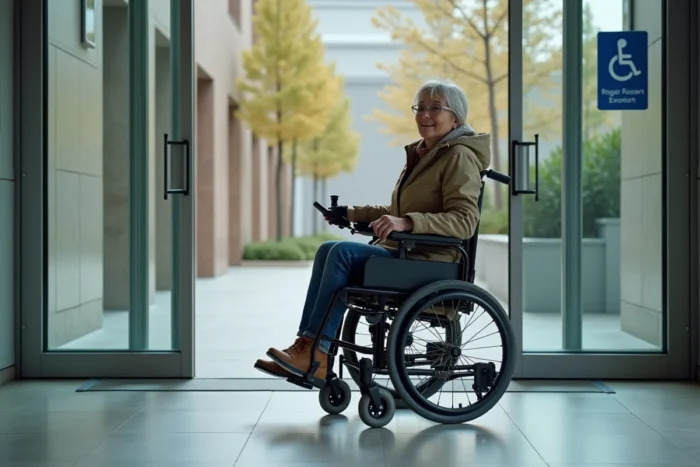
PMR access refers to all the provisions that allow people with reduced mobility to move around, enter, and use a place under conditions comparable to those of any other user. Behind this acronym lies a regulatory framework that goes far beyond the issue of wheelchairs.
Since the law of February 11, 2005, establishments open to the public (ERP) are required to ensure this accessibility. The scope of obligations continues to expand, now affecting professional buildings that were not previously concerned.
Equivalent quality of use: the principle that dimensional compliance alone is not enough to guarantee
Recent texts no longer only refer to door widths or ramp slopes. The regulation now aims for what is called equivalent quality of use: access conditions must be identical to those of able-bodied individuals or, failing that, offer comparable comfort of use.
This semantic shift has concrete consequences on the design of spaces. A business that installs a side ramp leading to a service entrance, technically compliant with regulatory dimensions, may not meet this criterion if the main entrance remains inaccessible. The proposed route must be as direct and dignified as that taken by other users.
To understand PMR access and its utility, it is essential to recognize that four major categories of disability are involved: motor, visual, auditory, and cognitive. A pathway adapted for wheelchairs but lacking tactile paving or contrasting signage remains incomplete under current regulations.

PMR accessibility beyond ERPs: what changes since October 2026
Until recently, accessibility obligations focused attention on ERPs and new housing. Since October 1, 2026, existing professional buildings (excluding ERPs) are more regulated when they undergo an extension or substantial modification. Simple maintenance or upkeep work remains excluded from the framework.
This extension of scope affects premises that largely escaped controls: corporate offices, workshops, warehouses with disabled staff reception. Project owners undertaking significant renovations must now integrate an accessibility aspect from the design phase.
Field feedback varies on how this obligation is applied in practice. Some construction professionals report a lack of clarity on the threshold that distinguishes a “modification” triggering the obligation from a simple interior rearrangement. This gray area generates case-by-case decisions, often resolved during the processing of building permits or prior work declarations.
Public accessibility register: a document often overlooked, rarely checked
Each ERP must maintain a public accessibility register, accessible to users. This document lists the measures implemented, any exemptions obtained, and staff training actions.
In practice, this register serves as the main piece of evidence in the event of a check or complaint. Its absence or incomplete nature exposes the operator to legal difficulties independent of the actual state of physical arrangements. An establishment that is perfectly accessible architecturally but lacks an up-to-date register remains in violation.
- The register must mention the services provided by the establishment and the accessibility conditions associated with each of them.
- Exemptions granted by the prefect must be included with their justification, whether due to structural constraints, heritage preservation, or economic disproportion.
- Awareness or training actions for staff in welcoming disabled persons must be documented, even if they are limited to an online module.
Despite its mandatory nature, the accessibility register remains a blind spot in many establishments. Competing content on the subject rarely mentions it, even though it represents a concrete lever for structuring compliance efforts.
Exemptions to PMR accessibility: three authorized cases and their limits
The regulations provide for cases where an ERP can obtain an exemption from accessibility rules. These exceptions are regulated and do not constitute a blank check.
- Technical impossibility: the building’s structure or terrain does not allow for the required adaptation without compromising the building’s integrity.
- Preservation of architectural heritage: the necessary work would irreversibly alter a classified or listed building under historical monuments.
- Manifest disproportion between the cost of the work and the financial means of the operator, or between the cost and the effects on the building’s use.
Each exemption must be validated by the prefect after consulting the departmental advisory commission on safety and accessibility. In return, the operator is required to propose substitution measures: reception at the entrance, adapted service in the room, provision of mobile equipment.
Resorting to exemptions does not exempt one from maintaining the accessibility register. On the contrary, exemptions must be explicitly recorded there along with the chosen compensatory solutions.

PMR accessibility and private housing: an angle often absent from the debate
The public debate on PMR access focuses on ERPs and roadways. Private housing remains an area where obligations are significantly less stringent for existing homes, even though this is often where daily difficulties manifest the most.
New housing must comply with accessibility standards (width of corridors, accessible shower, etc.), but old condominiums are not subject to any obligation for overall compliance. A co-owner wishing to install a ramp in common areas must obtain a vote in the general assembly, which can block even modest projects.
Accessibility is as much about the common areas of a building as it is about a business. The regulations treat these two situations very unevenly, and the available data do not allow for precise measurement of the extent of the accessibility deficit in the existing residential stock.
PMR access is not limited to a ramp or a pictogram on a door. It is a technical, legal, and human framework that continues to evolve, with gray areas that neither the texts nor field practices have yet fully resolved.