
Buying a decor item on a whim is something everyone has done. The vase ends up on a shelf, the cushion joins the pile, and the whole setup lacks coherence. To break this pattern, it often suffices to understand a few mechanisms that guide current trends.
Raw materials and artisanal textures: the anti-catalog filter
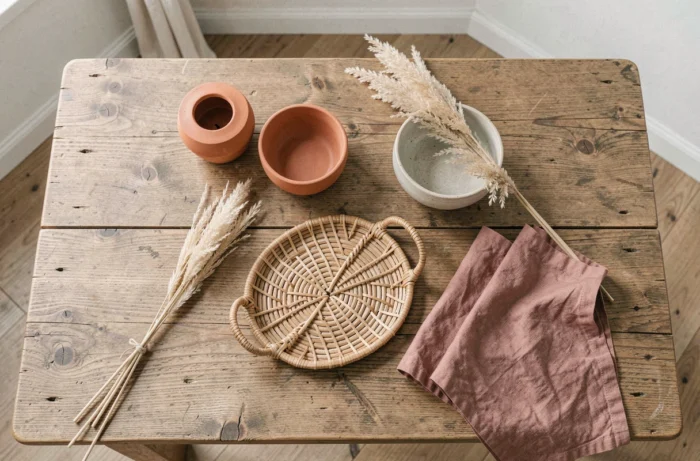
Have you noticed that the most photographed interiors rarely rely on smooth and uniform surfaces? This is not by chance. The current trend favors materials that bear the mark of a gesture: hand-glazed terracotta, crumpled linen, sculpted wood with visible knots.
This choice has a simple explanation. A textured object captures light unevenly. It changes appearance depending on the time of day. A raw stoneware vase placed near a window never looks quite the same in the morning and in the evening.
In practical terms, this means that a single artisanal object can replace three industrial knick-knacks in terms of visual impact. You can explore selections that gather this type of piece on the Camille Un Point C’est Tout shopping site, where references are sorted by style universe rather than by product category.
The idea is not to fill a space, but to create focal points. A woven rattan light fixture above a table, an irregularly framed mirror in an entryway: each piece stands alone and tells a story.
Second-hand and decor: a reflex that has become common in France
The second-hand decor market is no longer marginal. A large majority of French people report having no problem buying second-hand furniture. Among 25-44 year-olds living in cities, it has become a fully-fledged shopping reflex, motivated as much by budget as by environmental awareness.
This shift changes the way we “shop” for decor. Instead of browsing a catalog to find a coordinated collection, we hunt for a unique piece that sets the tone for a room. A 1970s marquetry coffee table paired with a contemporary sofa creates a richer contrast than a set bought all at once.
What sells well (and why it’s a style indicator)
Observing what sells quickly on resale platforms provides a reliable insight into current tastes. The most sought-after pieces share a few traits:
- Furniture in saturated colors inspired by the 1960s-1970s, such as mustard velvet armchairs or terracotta lacquered buffets, find buyers within days.
- Suspensions made from natural materials (rattan, paper, pleated fabric) attract buyers looking for warm lighting without going for new.
- Objects in tinted glass, vases or bowls, appeal because they filter light and add color without painting a wall.
This second-hand market also pushes brands to design more durable pieces, intended to age well. A piece of furniture designed to last twenty years also retains its resale value, which changes the calculation at the time of purchase.
European ecodesign regulation: what it changes for your decor purchases
The European regulation ESPR (Ecodesign for Sustainable Products Regulation), which came into effect on July 18, 2024, extends ecodesign requirements well beyond electrical appliances. Furniture is now included.
Why is this relevant when talking about decor shopping? Because this regulation will gradually require manufacturers to provide information on the durability, reparability, and recyclability of their products. In practice, this means that product sheets will be enriched with verifiable data.
Reading a decor product sheet differently
Before this regulation, comparing two coffee tables often meant comparing two photos and two prices. With the gradual introduction of ESPR criteria, you will be able to check:
- The origin of the materials and their recycled content.
- The possibility of replacing a damaged component (a leg, a top) without discarding the whole piece.
- The estimated carbon footprint of the product, from manufacturing to delivery.
This regulatory framework favors brands that already work with raw materials and artisanal processes. Small furniture publishers are gaining an advantage over giants of standardized furniture because their short production chains naturally meet these criteria.

Slowdown in the French furniture market: arbitrate rather than accumulate
In May 2026, the French furniture market declined by 6.9% in value according to the economic note from IPEA (Institut de la Maison). This is the most significant drop since the beginning of the fiscal year. This contraction pushes consumers to make more decisive choices.
In practical terms, the decor budget focuses on fewer pieces, but better chosen. Rather than a complete renewal of the living room, we invest in one or two visually impactful objects: a sculptural light fixture, a large-format mirror, a piece of upholstery that transforms the ambiance.
This logic of arbitration aligns with the rise of DIY. Content related to “homemade” decor is experiencing growing audiences on social media, a sign that customizing an existing piece of furniture (repainting, reupholstering, repurposing) is becoming a credible alternative to buying new.
Decor shopping in 2026 is no longer just about flipping through catalog pages. Choosing an artisanal piece instead of three generic objects, checking the durability of a piece of furniture before buying it, hunting for a vintage chair that adds character to a room: these actions create an interior that reflects its inhabitant, not a store display.