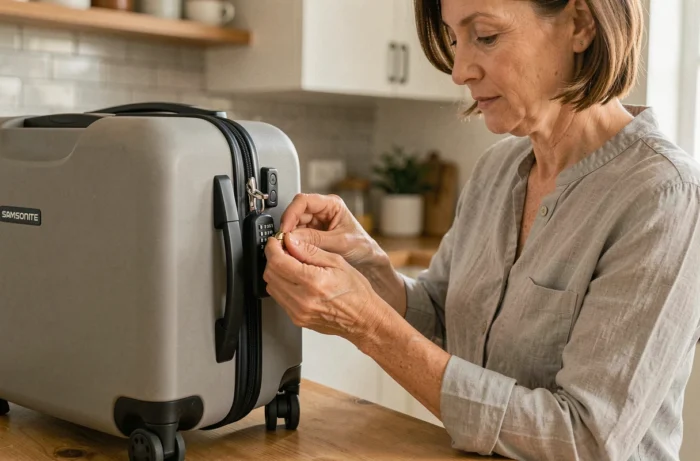
When packing your Samsonite suitcase for a flight, you decide to customize the TSA007 lock code, and upon your return, you can’t open it. The lock refuses the new combination. This scenario happens more often than one might think, and most of the time, the issue is not with the lock but with a step that was not properly secured during handling.
Handling Errors with TSA007: Why the New Code Doesn’t Work
The TSA007 lock on Samsonite suitcases operates with a reset mechanism using an internal button or lever. The catch is that the procedure varies depending on the exact model of the suitcase. Samsonite now offers dedicated PDFs and videos for each reference rather than a universal method.
The most common case: you press the reset button, enter the new code, but release the pressure before fully validating the combination. The mechanism then silently reverts to the factory code 0-0-0 without you noticing. You close the suitcase, leave, and upon arrival, the chosen code no longer matches.
User feedback describes exactly this type of situation: an unrecorded reset action causes a return to the factory code during transit. Tutorials often present the procedure as foolproof, but on recent Samsonite models, locking in the new code requires a firm mechanical confirmation, not just a light touch.
Before attempting anything, you can consult the detailed procedure to change the Samsonite TSA007 suitcase code in case of a lost code or blockage after a mishandling.
Reliable Procedure for Changing the Samsonite TSA007 Combination
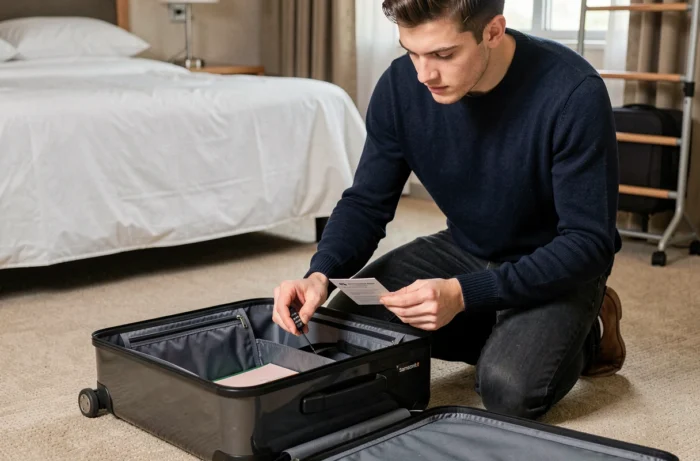
Rather than following a generic tutorial, here is the sequence that minimizes the risk of blockage. We assume that the suitcase is open and that the current code still works (factory code 0-0-0 if it’s the first use).
- Align the dials to the current code (0-0-0 by default). Ensure that the sliders move freely and that the lock is in the open position.
- Press the reset button with a ballpoint pen or a thin object. On some models, it is a lever that needs to be turned. Maintain pressure without releasing throughout the next step.
- Enter the desired new code by turning the numbers one by one, with slow and firm movements. You should feel each dial click into place.
- Release the button (or return the lever to its initial position). A small click confirms that the new combination is recorded.
- Immediately test the new code by closing and then reopening the lock at least twice. If the lock jams, the code has not been registered: start over with the combination 0-0-0.
The critical point is the immediate test. Many travelers close their luggage directly without verification. It is recommended to note the new code on your phone or take a photo, a practice that Samsonite itself suggests in its recent FAQs.
Differences Across Samsonite Ranges
On hard-shell ranges (like polycarbonate), the reset button is usually located in a small hole between the dials. On soft zipper models, the mechanism may include a side lever. Consulting the PDF for the exact model on the Samsonite website avoids guesswork.
Feedback varies on this point: some users find the lever more intuitive than the button to press, while others report that it is easy to confuse the “open” and “reset” positions on the levers. When in doubt, the official video of the model remains the most reliable reference.
TSA007 Lock Jammed After Code Change: Concrete Solutions
If the new code no longer works and you find yourself in front of a locked suitcase, the first thing to try is the combination 0-0-0. In the majority of failed handling cases, the lock has reverted to the factory code.
If 0-0-0 doesn’t work either, move on to the manual method:
- Apply slight tension on the opening button or the zipper sliders, as if trying to open the suitcase.
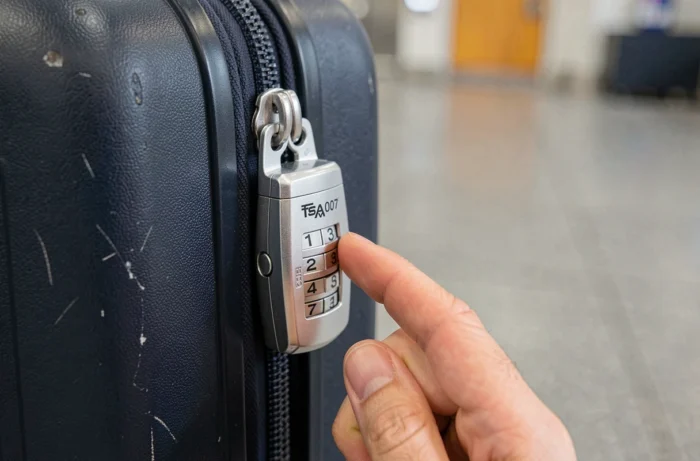
- Turn the first dial very slowly. When the correct number passes, you will feel a different resistance, a micro-click, or a slight additional play in the mechanism.
- Repeat the operation for each dial while maintaining constant tension.
This method requires patience. Articles promising to recover your TSA007 code in a few minutes underestimate the precision of recent Samsonite locks. Current mechanisms offer less mechanical play than older models, making tactile detection more subtle.
When to Contact Samsonite or a Locksmith
If the manual method fails after several attempts, Samsonite offers a customer service that can intervene on the lock. This is an official solution rarely mentioned in tutorials, which mainly focus on DIY. Forcing the lock or attempting to pick it may damage the mechanism and void the warranty.
Precautions to Avoid TSA Code Locking During Travel
The real issue with changing the code is timing. Modifying your combination just before checking in your luggage leaves no margin for verification. You may find yourself at your destination airport with a potentially misconfigured lock.
Changing your code at least the day before departure allows you to test the opening and closing several times in calm conditions. It’s also the time to check that the dials turn without forcing and that the sliders respond normally.
A final often-overlooked point: TSA security agents in the United States have a universal key to open TSA007 locks during inspections. They then close the suitcase but do not check the repositioning of the dials. It can happen that a suitcase leaves with the dials misaligned after a check, giving the impression that the code has changed by itself. Checking the lock upon receiving the luggage is part of the reflexes to adopt.