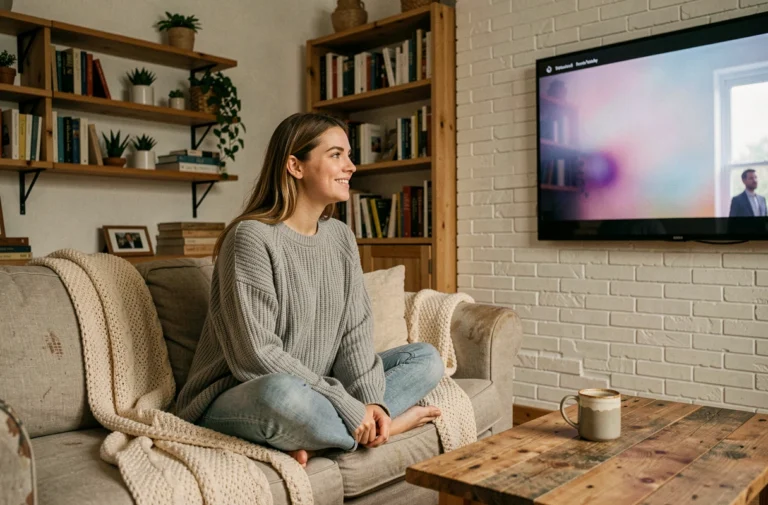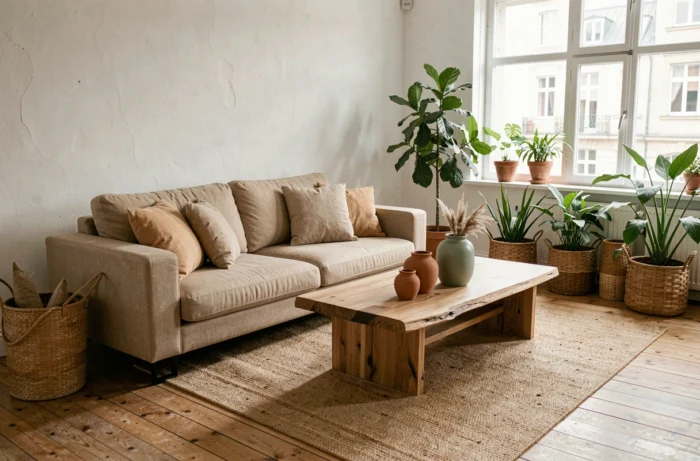
A sofa you love, walls whose color bores you after six months, a living room that lacks depth without you knowing why: interior decoration often hinges on details that are overlooked. Current decor trends, however, offer concrete ideas to transform a mundane space into a unique living area, provided you understand the visual mechanisms behind each choice.
Sculptural furniture and tactile textures: the decor axis that changes the perception of a room
Have you ever noticed that a living room furnished with straight-lined pieces, all at the same height, seems frozen? It’s a problem of visual rhythm. The eye needs variations in shapes and materials to flow through a space.
Sculptural furniture precisely meets this need. A raw travertine coffee table, an armchair with organic curves, or an asymmetrical light fixture do more than just decorate. They create visual anchor points that structure the room as much as a partition would.
This approach fits within what designers call warm minimalism. The principle: maintain clean lines, but replace smooth, cold surfaces with rich textures. A boucle wool throw on a simple sofa, a stoneware vase on a lacquered console, a jute rug under a glass table. Each material contrast adds a layer of depth without cluttering.
Specifically, if your living room feels flat, start by replacing just one element (the coffee table or the main light fixture) with a piece of less predictable shapes. The effect on the overall ambiance is often disproportionate to the investment. To rethink the home with Les Embellies Déco, this type of targeted substitution yields quick results without a complete overhaul.
Earthy colors and deep shades: choosing a palette that lasts
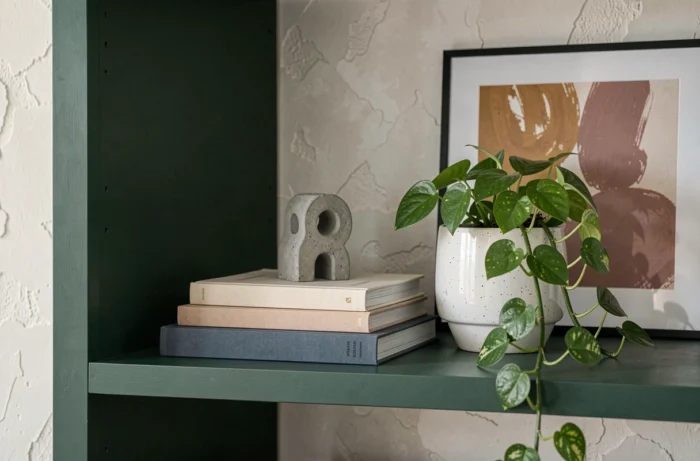
White walls are reassuring, but they eventually erase the personality of an interior. Conversely, a color that is too bright can become tiring in just a few months. The sweet spot lies in earthy tones and deep shades: tobacco brown, eggplant, lime, burnt ochre.
Why do these colors work better over time? Because they adapt to natural light throughout the day. An eggplant wall appears dark in the morning and almost warm in the evening under indirect lighting. A rosy beige captures the reflections of the setting sun. These variations make the room feel alive without needing to change anything.
Combining colors without bad taste
The most reliable rule remains that of proportion. Choose a dominant shade for large surfaces (walls, floor), a secondary shade for main furniture, and a third, more assertive one for objects and textiles.
- Dominant (about two-thirds of the visible surface): a neutral and warm tone, like sandy beige or taupe gray
- Secondary (furniture, curtains): a medium color, such as sage green or soft terracotta
- Accent (cushions, vases, frames): a bolder shade, like midnight blue or burgundy, that draws the eye to specific points
Three shades are enough to structure an entire room. Beyond that, the whole may appear scattered. This rule applies to both the living room and the bedroom.
Art and decorative objects: creating focal points without overloading
Accumulating frames on a wall does not create a gallery. It creates visual noise. The current trend favors reduced but deliberate choices: one large canvas instead of ten small ones, a ceramic object placed alone on a shelf instead of ten knick-knacks lined up.
A focal point works when it contrasts with its immediate environment. A brightly colored painting on a neutral wall captures attention. The same painting on a wall already filled with patterns disappears. The principle is simple: the calmer the background, the more presence the highlighted object gains.
Lighting to enhance
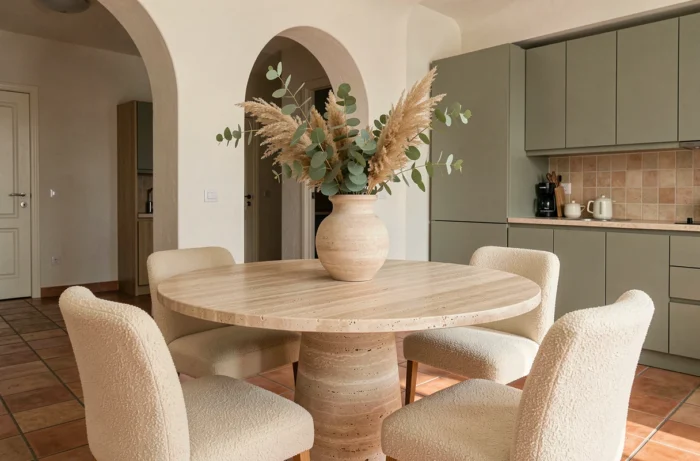
Lighting radically transforms the perception of a decorative object. A wall sconce directed at a painting completely changes its visual impact. Conversely, a central ceiling light flattens the reliefs and textures.
Think in layers of light: soft general lighting (dimmer pendant or ceiling light), directional sources for focal points (adjustable spotlights, table lamps), and low ambient lighting (discreet string lights, candles). Three levels of light add depth to any room.
Natural materials and sustainable approach: a style that builds over time
Raw wood, linen, stone, rattan: these materials are making a strong comeback, but not as mere accessories. They become the structural foundation of the decor. A solid oak tabletop, recycled wood shelves, textiles made from natural fibers provide a coherence that plastic or melamine cannot replicate.
The concrete advantage of these materials is that they patina instead of degrading. A solid wood piece gains character over the years. A linen sofa wrinkles in a way that is part of its charm. This natural patina avoids the syndrome of furniture that looks worn out after two years.
- Favor solid wood or quality plywood for structural furniture (table, bookshelf, sideboard)
- Choose textiles made from natural fibers (linen, thick cotton, wool) for elements you touch daily
- Incorporate one or two objects made from recycled materials (blown glass, reclaimed metal) to add a unique dimension
This logic aligns with biophilic design, which involves integrating nature-inspired elements into the home. A few well-placed green plants, a natural stone floor, or simply a wicker basket are enough to anchor an interior in something tangible.
Enhancing an interior does not require a complete replacement. A sculptural light fixture, a narrowed color palette, rethought lighting, or a well-chosen noble material can transform the reading of an entire room. The common thread remains the same: every visible element must have a reason for being there.