
Homemade mayonnaise is based on a simple physical principle: dispersing micro-droplets of oil into an aqueous phase (egg yolk, mustard, vinegar) to form a stable emulsion. The choice of utensil determines the size of these droplets, the amount of air incorporated, and the final stability of the sauce.
Balloon whisk, electric mixer, stand mixer, or immersion blender do not produce the same result at all. The right tool depends as much on your preparation volume as on your tolerance for the risk of failing the emulsion.
Balloon whisk, electric mixer, and immersion blender: performance comparison
| Criterion | Balloon whisk (manual) | Electric mixer | Immersion blender |
|---|---|---|---|
| Speed control | Total (wrist strength) | Variable by model (3 to 5 speeds) | Often a single speed, pulse on some models |
| Risk of slicing the mayo | Low (instinctive adjustment) | Moderate (too high speed at start) | Low if jar technique is adapted |
| Texture obtained | Light, airy | Firm, dense | Very firm, not airy |
| Preparation time | Several minutes of vigorous whisking | Quick | Very quick |
| Cleaning | Simple (one utensil) | Moderate (removable whisks + body) | Simple (removable foot) |
| Suitable for small quantities | Yes | Moderate (whisks spin empty) | Yes (narrow jar) |
This table highlights a point that recipes often overlook: the final texture changes radically depending on the tool used. A balloon whisk incorporates more air, resulting in a softer and lighter mayonnaise. The immersion blender, on the other hand, produces a dense and compact emulsion in a matter of seconds.
To choose a whisk or mixer for mayonnaise, the starting question should focus on the texture you are aiming for, not just on ease of execution.
Minimum speed of the mixer: the factor that changes everything for the emulsion
The majority of mayonnaise failures with an electric mixer stem from starting too quickly. The oil, poured in a thin stream, must be gradually incorporated into the egg yolk. If the mixer runs too fast from the first seconds, the oil droplets remain too large, and the emulsion does not form.
A mixer with a truly low minimum speed stabilizes the emulsion from the start. Recent stand mixers offer very fine speed settings, sometimes a dozen levels, allowing you to start almost at a crawl and then gradually accelerate. This is a concrete advantage over entry-level hand mixers, which are often limited to three speeds, with the first remaining high.
What speed changes concretely
- Below a certain rotation speed, the whisk wires slice the oil into very fine micro-droplets, producing a stable emulsion that is hard to slice.
- Beyond that, the movement creates turbulence that prevents the oil from dispersing evenly, especially in the first few seconds when the liquid volume is low.
- The planetary motion of stand mixers (the whisk rotates on itself while moving around the bowl) covers the surface of the mixture better than a fixed hand-held mixer, reducing non-emulsified areas.
If you have a hand-held electric mixer, the workaround is to pour the oil drop by drop during the first minute, then in a fine stream once the emulsion has started. This gesture partially compensates for the lack of finesse in the setting.
Food safety and choice of utensil: an underestimated link
Homemade mayonnaise uses raw egg yolks. During hot weather, health authorities regularly remind us of the risks of food poisoning associated with this type of preparation. The time that ingredients spend at room temperature during preparation plays a direct role in bacterial proliferation.
A tool that reduces preparation time limits the exposure of raw eggs to ambient heat. The immersion blender, which produces mayonnaise in seconds, has an objective advantage in this respect compared to the manual whisk, which requires several minutes of vigorous work.
Adapting the quantity to the tool
The manual whisk excels for small quantities, consumed immediately. If you are preparing mayonnaise for a meal in advance, a mixer or blender reduces the handling window and allows you to refrigerate the result more quickly.
Micro-electromechanical devices dedicated to emulsions, recently appearing on the market, specifically target this niche: producing a small amount of mayonnaise in seconds, in a closed container that goes directly into the refrigerator. Their interest remains limited if you regularly cook with an immersion blender or a stand mixer, but they meet a real need for occasional cooks.

Material and shape of the whisk: stainless steel, silicone, and number of wires
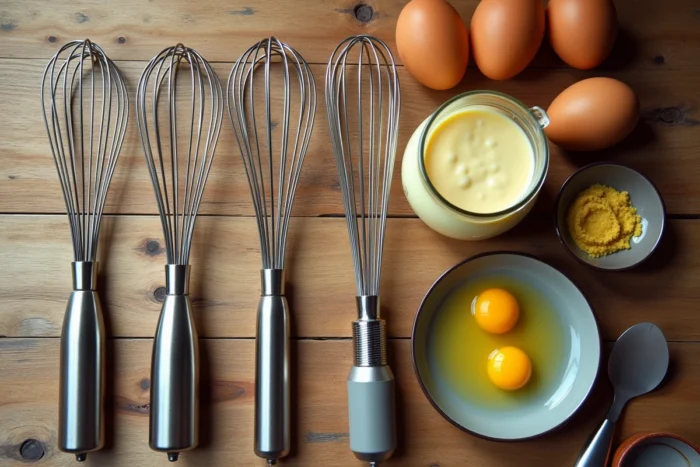
The material of the whisk influences the rigidity of the wires and thus the ability to incorporate air into the emulsion. Stainless steel remains the standard for mayonnaise: its rigid wires effectively transmit mechanical energy to the mixture. A silicone whisk, being more flexible, is better suited for preparations in fragile-coated containers, but its performance on a thick emulsion is lower.
Shape also matters. A balloon whisk, with its spaced wires and rounded profile, traps more air than a flat whisk or a spring whisk. For a light and frothy mayonnaise, the balloon is the most suitable format.
Number of wires and ergonomics of the handle
The more wires the whisk has, the finer it slices the oil with each pass. An eight-wire whisk works significantly slower than a twelve or sixteen-wire model. The handle also deserves your attention: a handle that is too thin tires the hand during a long preparation, and a smooth plastic handle can slip with oily fingers.
The choice between manual whisk and mixer comes down to a trade-off between sensory control and mechanical efficiency. The stainless steel balloon whisk offers the best perception of the mixture, allowing you to feel the exact moment when the emulsion takes.
The mixer or immersion blender reduces effort and time, at the cost of a lesser connection with the preparation. For everyday mayonnaise, the immersion blender in a narrow jar remains the most reliable method. For the pleasure of the gesture and a lighter texture, the manual balloon whisk has no equivalent.