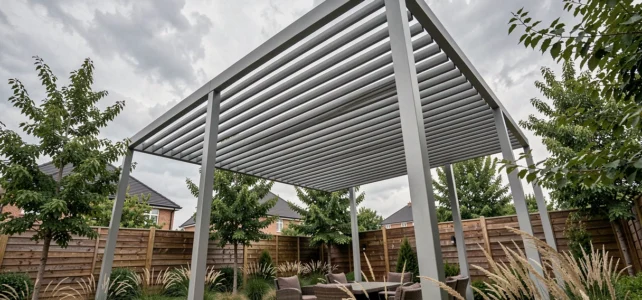
A sudden gust can turn a bioclimatic pergola into a wind trap if the slats are poorly positioned. The question of slat orientation in strong winds is not merely a simple act of closing them: it involves the structural integrity of the whole system, the safety of the occupants, and the longevity of the tilting mechanism.
Open slats during gusts: the risk that manuals downplay
Most guides focus on closing the slats as a safety reflex. The real issue lies upstream: a pergola left open by oversight during a sudden windy episode undergoes mechanical stresses for which it was not designed.
Recent field reports, particularly highlighted by specialized comparisons, point out the specific vulnerability of “left open” configurations when the wind rises quickly. The challenge is therefore not only the angle of opening at the moment of intervention but also the operational anticipation before the gusts.
The questions to consider regarding the orientation of bioclimatic pergola slats and strong winds go beyond simple manual adjustment: should one close completely, tilt at a precise angle, or leave a controlled air passage depending on the wind direction?
Complete closure or partial tilt: what mechanics dictate
Closing the slats flat (closed horizontal position) is the most common reflex. This position transforms the roof into a solid surface, which has an obvious advantage: the slats do not vibrate and are unlikely to twist. The aluminum structure then withstands the wind pressure like a rigid panel.
However, this configuration generates a lift effect when the wind strikes from below, particularly on freestanding pergolas installed as islands in a garden. The upward pressure acts on the entire surface of the roof.
Partial tilting, sometimes recommended by certain installers, is based on a different logic: allowing part of the air flow to pass through the slats to reduce the overall wind catch. This approach makes sense on paper, but it exposes each slat individually to turbulence. Field feedback varies on this point, as behavior depends on the width of the slats, their thickness, and the quality of the rotation axes.
The specific case of the wall-mounted pergola
A pergola attached to the facade of a house benefits from a partial masking effect. The rear wall blocks the wind coming from that direction, which reduces the stresses on the roof. In this case, complete closure of the slats remains the safest position, as the lift effect is limited by the anchoring to the building.
For an island pergola, exposed to all winds, the situation is more complex. Some manufacturers then recommend a slight tilt combined with the closure of the side walls, when they exist.
Wind sensor and automatic closure: a differentiating criterion
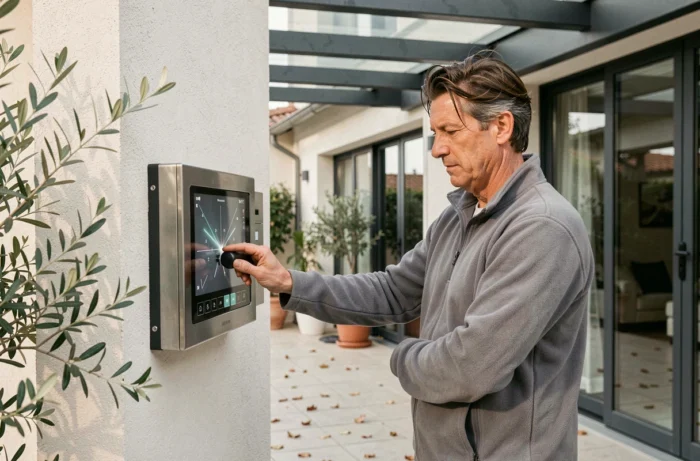
The question of automatic closure via a wind sensor has become a differentiating criterion between entry-level bioclimatic pergolas and more advanced models. The principle: an integrated anemometer triggers the closure of the slats as soon as a wind threshold is reached, without human intervention.
This device directly addresses the problem of “forgotten slats in the open position.” Recent commercial manuals emphasize the overall certification of the system rather than just the mechanical resistance of the structure.
- A wired or wireless wind sensor, coupled with the motorization of the slats, automatically closes the roof within seconds
- The triggering threshold is generally adjustable, allowing it to be adapted to local conditions (coastal areas, urban wind corridors, exposed plains)
- Some systems couple the wind sensor with a rain sensor, triggering closure based on two distinct criteria
The European standard EN 13561, which classifies the wind resistance of external protections, is increasingly used as a reference in the industry. It does not apply directly to bioclimatic pergolas in the same way as to awnings, but manufacturers use it as a framework to certify their systems.
Wind direction and pergola orientation on the terrace
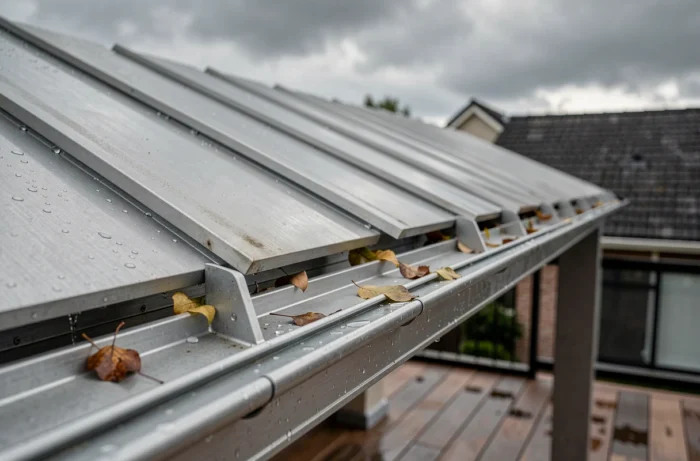
The orientation of the slats cannot be considered without taking into account the orientation of the pergola itself in relation to the prevailing winds. The slats of a bioclimatic pergola are generally parallel to each other, and their axis of rotation follows a defined direction at installation.
If the slats are perpendicular to the prevailing wind, the pressure acts directly on their surface. If they are parallel to the airflow, it slips between them when they are open, which reduces mechanical stress but complicates rain tightness.
Adapting the adjustment to local weather
In areas exposed to regular winds (coastal, narrow valleys), the choice of slat orientation at the time of installation conditions all subsequent maneuvers. It is a structural decision, not a seasonal adjustment.
- In coastal areas, orienting the axis of the slats parallel to the prevailing winds limits wind catch when open
- In urban areas, the turbulence created by neighboring buildings makes gusts unpredictable in direction: automatic closure then becomes the main safety net
- In plain areas, winds are often more regular in direction but can reach high speeds: the strength of the ground anchors takes precedence over the angle of the slats
The anchoring of the pergola to the ground, whether by bolted plates on a concrete slab or chemical anchoring, determines the overall resistance far beyond just the orientation of the slats. A perfectly adjusted aluminum pergola but poorly anchored remains vulnerable, regardless of the chosen angle.
The reflex to remember is the simplest: close the slats and side walls as soon as the wind picks up, rather than trying to find the right angle during a gust. The technology of automatic sensors makes this precaution less dependent on human vigilance, but it does not replace a properly dimensioned installation from the start.