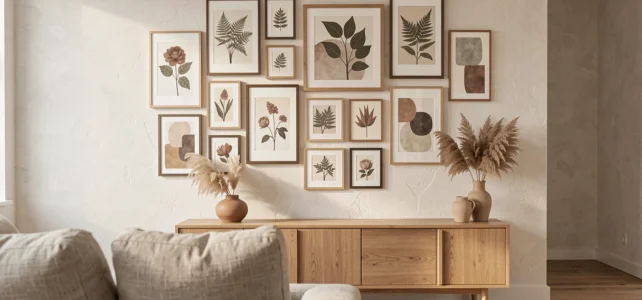
A white wall above a sofa is often the first place the eye lands when entering a living room. It’s also the one we constantly push aside: too big, too visible, too risky. Trendy wall decorations can transform this empty surface into a true visual anchor, provided we move beyond generic solutions.
Colour drenching on an accent wall: wall decoration that does without frames
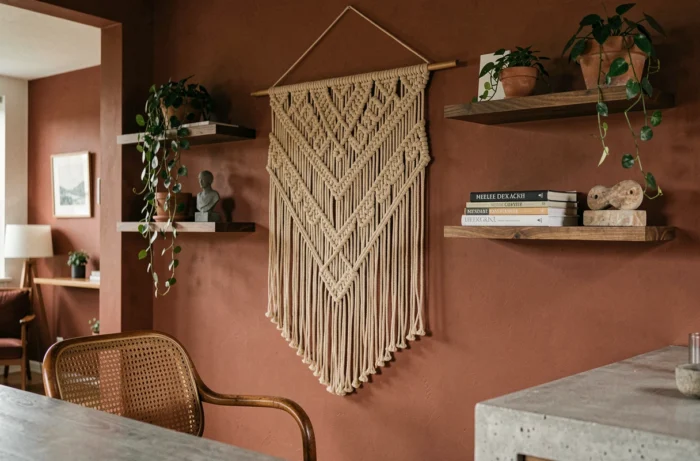
Before hanging anything, we can start with the color of the wall itself. Colour drenching, a strong trend since 2025, involves painting the wall, baseboards, door frames, and even the ceiling in a single shade. The effect is immersive: the room gains depth without a single object being fixed.
Specifically, we choose a deep hue (aubergine, tobacco brown, forest green) and apply it to all surfaces of a wall section, including the woodwork. The result eliminates visual breaking lines between wall and joinery. Colour drenching replaces a gallery wall with an enveloping wall, which is particularly suitable for narrow rooms where multiplying frames creates a cluttered effect.
A wide selection of finishes and complementary wall accessories can be found at wallstore.be, especially to pair solid colors with discreet decorative elements without overwhelming the whole.
If the idea of painting an entire wall holds you back, a lighter version works well: apply the same shade only on the wall and its baseboards, leaving the ceiling neutral. The enveloping effect remains perceptible without total commitment.
Indoor plant wall: when wall decoration becomes alive
Plant walls are no longer reserved for hotel lobbies or architect offices. In recent years, design magazines have described them as a true residential wall trend. We’re talking about modular plant frames, not entire facades.
A small plant frame installs like a painting, with an integrated water reservoir and a substrate suitable for shade plants (stabilized moss, ferns, pothos). The main constraint is watering: reservoir systems limit maintenance to about once a week, but feedback on this varies depending on exposure and room humidity.
Choosing between stabilized and living plants
The stabilized (moss, lichen treated with glycerin) requires no maintenance and retains its appearance for several years. In return, it does not evolve and does not filter the air.
The living option adds relief and changes with the seasons, but requires a minimum of indirect light and an irrigation system. For a dark hallway, the stabilized option is the logical choice. For a bright living room, the living plants add a dimension that the frozen moss cannot offer.
Asymmetrical wall compositions: going beyond the grid of aligned frames
The classic gallery wall (identical frames, regular spacing) remains a common reflex. We see it everywhere; it works, but it no longer surprises. The alternative gaining ground is to mix formats, materials, and heights on the same wall.
Here are the elements that can be combined in a successful asymmetrical composition:
- One or two paintings of different sizes, placed at staggered heights to break the horizontal line.
- A round or organic mirror that reflects light and visually enlarges the space, placed slightly off-center in the composition.
- A thin wall shelf (raw wood or black metal) that holds a small object, a candle, or a plant, creating volume against flat surfaces.
- A textile element, such as macramé weaving or contemporary tapestry, that breaks the rigidity of frames and adds texture.
The operational rule: start with the largest piece, position it slightly above the center of the wall, then build around it, leaving irregular spaces. A gap of a few centimeters between two neighboring frames, then a wider void elsewhere, creates a natural rhythm.
Materials to combine to avoid a catalog effect
A wall entirely covered with identical black frames produces a monotonous effect. Alternating light wood, brass, and borderless frames (stretched canvas) is enough to create contrast. One can also integrate an unframed object, such as a piece of driftwood or a woven basket, to break the geometry.
Panoramic wallpaper: large format wall decoration for a living room or bedroom
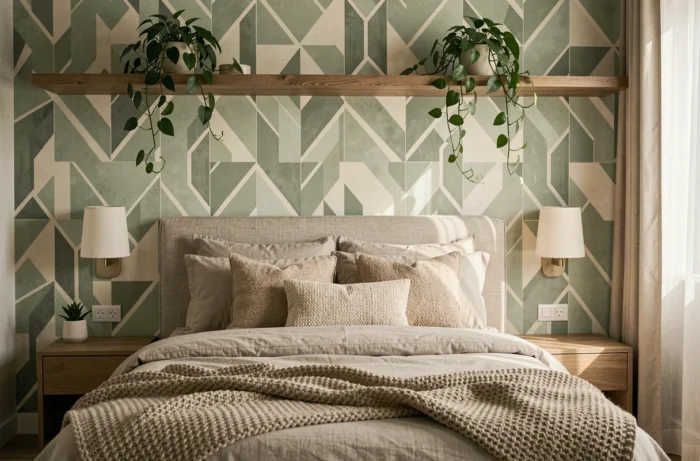
Panoramic wallpaper is making a strong comeback, but not in its heavy version from the 1980s. Current strips feature trompe-l’œil patterns, misty landscapes, or abstract textures that function as a unique mural on a single wall.
Installing a panoramic wallpaper on the wall facing the entrance of a room increases the visual impact. On a side wall, the effect is more subtle but can visually elongate a narrow space, especially with a perspective pattern (deep forest, successive arches).
Two practical precautions before diving in:
- Measure the ceiling height accurately: a panoramic wallpaper cut awkwardly at the top or bottom loses all its effect.
- Ensure the wall is smooth and dry. On an old wall with micro-cracks, a preparatory undercoat prevents bubbles and premature peeling.
- Choose a sufficiently dense weight for a non-woven wallpaper that rests easily if you want to change the decor in a few years.
The panoramic wallpaper stands on its own: avoid placing frames or shelves over it, as this risks muddling the pattern’s reading. A discreet wall-mounted light fixture remains the only addition that works without competing with the visual.
Transforming a wall does not necessarily require a large budget or heavy work. An immersive color panel, a plant frame, an asymmetrical composition, or a well-placed panoramic wallpaper is enough to give character to a room starting from a single wall. Often, the most effective approach is to treat one wall with conviction rather than scattering small decorative elements across all available surfaces.