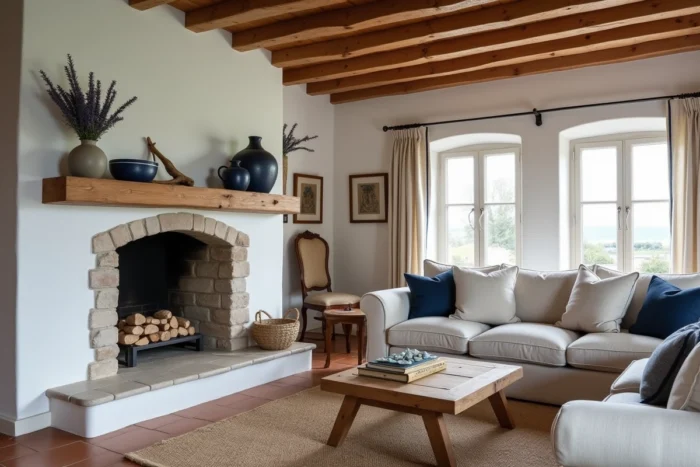
The Breton-inspired decor relies on a precise vocabulary of materials and textures related to the regional architecture: granite, slate, timber, lime plasters. Adapting these elements to a contemporary interior requires understanding how each material interacts with the region’s humid climate, not just choosing a color palette.
Breathability of stone walls and compatible decorative choices
In an old Breton house, granite or schist walls act as humidity regulators. They absorb water when the air is saturated and release it when it dries out. This cycle, known as wall perspiration, directly influences indoor comfort and the durability of the structure.
Applying a cement plaster, waterproof acrylic paint, or sticking vinyl wallpaper on these walls effectively blocks this mechanism. Moisture becomes trapped in the masonry, leading to efflorescence, mold, and degradation of the joints. Craftsmen specialized in Breton heritage recommend natural hydraulic or air lime plasters, which allow water vapor to pass while providing a smooth or slightly textured finish.
For those who wish to leave the stone exposed, a simple brushing followed by a mineral treatment is sufficient. Raw stone already brings a visual warmth that few coverings can match. Combined with wall-mounted lighting, it becomes the main decorative element of the room, without any superfluous additions. Catalogs like the one available at littlebreizh.fr offer objects and accessories designed to fit into this type of interior without overwhelming it.
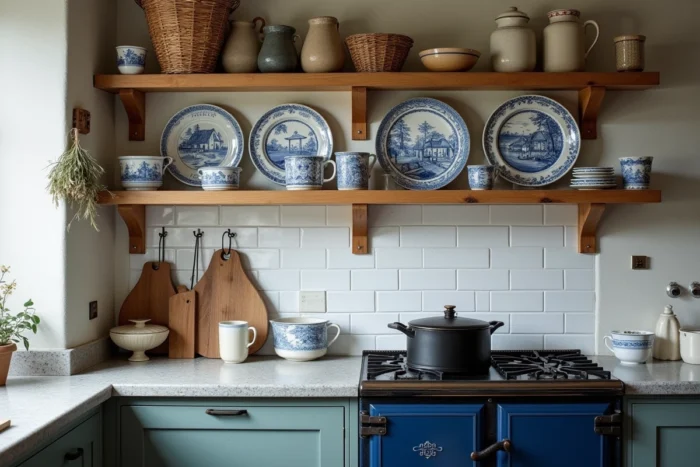
Breton color palette: beyond navy blue and white
The navy blue and white reflex is more associated with beach imagery than with traditional Breton housing. The interiors of long houses and village homes historically relied on the shades of local materials: light gray granite, warm brown chestnut beams, ochre from terracotta floors.
The current trend in Breton renovations favors a soft, earthy palette: beige, sand, ecru, sage green, terracotta. These tones work particularly well with the region’s natural light, which is often diffuse and changeable. A wall painted in sage green in a northwest-facing room captures the low light better than a deep blue, which tends to darken the space.
Matching shades with raw materials
The principle is simple: the wall color should converse with the existing architectural elements, not compete with them. If the room has exposed dark oak beams, an ecru or sand wall creates a soft contrast. If the beams have been painted white (a common practice in 1990s renovations), a more pronounced shade like ochre or terracotta adds depth.
Whether or not to paint the beams is a defining choice for the entire room. Stripping them to reveal the raw wood requires significant work (sanding or chemical stripping), but the result immediately anchors the interior in its regional identity.
Vintage furniture and objects: creating an ambiance without overload
The difference between a warm Breton interior and a folkloric accumulation lies in the selection. A few well-chosen pieces are enough. Warm minimalism, prevalent in recent decoration projects in Brittany, involves keeping the old character visible while limiting the number of exposed objects.
- An antique oak or chestnut dresser, used as open storage in the kitchen or living room, advantageously replaces several modern pieces while serving as a focal point
- Raw linen textiles (cushions, throws, light curtains) add texture without imposing patterns, and their slightly wrinkled appearance complements the irregularity of the stone
- Locally crafted objects (stoneware ceramics, earthenware bowls, patinated metal light fixtures) integrated in small touches avoid the thematic collection effect
A common mistake is to multiply maritime symbols: ropes, model boats, decorative anchors. One or two elements evoking the coastline are sufficient throughout the home. A convincing Breton interior relies on materials, not symbols.
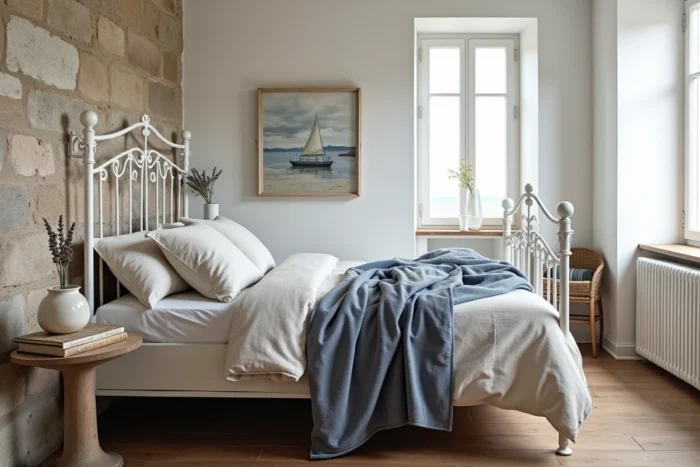
Lighting and textiles for a bright Breton home
Brightness in Brittany varies significantly with the seasons. Artificial lighting plays a crucial role in the feeling of warmth, especially during the autumn and winter months. Suspensions made from natural materials (rattan, linen, aged metal) diffuse a soft light that highlights the raw textures of the walls and furniture.
Windows and curtains suited to the architecture
Old Breton houses often feature narrow openings and characteristic small panes. Rather than masking them with thick curtains, washed linen sheers filter light while preserving privacy. Their lightness contrasts with the thickness of the walls, enhancing the feeling of interior softness.
In north-facing rooms, an antique mirror placed opposite the window amplifies the available natural light. This simple gesture, which does not alter the structure of the building, significantly transforms the atmosphere of a dark room.
The floor also deserves special attention. Old tiles or schist slabs visually warm up with a thick wool or braided jute rug placed in the main living area. The contrast between the mineral quality of the floor and the softness of the textile creates the essence of comfort.
A successful Breton decor relies less on the accumulation of regional objects than on the coherence between the building materials and the design choices. Respecting the breathability of the walls, working with natural light rather than against it, and limiting decorative additions to pieces that bring real texture: these three considerations are enough to transform a stone interior into a space that is both authentic and comfortable.