
A sitemap is not just an XML file submitted to Google Search Console. On a decor site, where the structure mixes product categories, inspiration pages, blog articles, and technical sheets, the sitemap becomes a tool for structural reading. We use it as much to audit a site’s coverage as to understand how its content is prioritized even before navigating the interface.
Faceted navigation and sitemap: the trap of duplicate URLs in decor
Decor sites heavily rely on filters: color, material, style, room, price range, availability. Each combination of filters generates a distinct URL. Without moderation, a sitemap can reference thousands of nearly identical pages, diluting the crawl budget on variations that have no inherent SEO value.
The sitemap must strengthen the hierarchy of discovery of the most important pages, not mechanically reflect all the URLs produced by the filter interface. In practice, only the main categories and high-search-volume intersections deserve to be included. The remaining combinations fall under noindex or canonical tags, not the sitemap.
By consulting the sitemap of Elle Imagine, one can observe an example of readable structuring where category pages and editorial content are clearly separated from filter variations. This type of reading allows for the identification of the actual depth of the catalog and the ranking logic retained in just a few seconds.

Image sitemap on a decor site: what Google really uses
A decor site thrives on its visuals. Mood photos, situational setups, texture details: these visual contents often represent the majority of image traffic. Google’s documentation has evolved regarding media sitemaps, and the fields that still matter are now well-defined.
For images, Google only utilizes the image:loc tag in the sitemap. Fields like image:caption or image:title, once documented, are no longer mentioned as active signals. Adding outdated metadata to the image sitemap burdens the file without indexing benefits.
On a highly visual decor site, we recommend limiting the image sitemap to the main visuals of each product sheet and each inspiration article. Thumbnails, small format color variants, and interface icons have no reason to be included. An image sitemap focused on visuals with high search potential (queries like “bohemian living room,” “terrazzo kitchen”) generates more effective indexing than a comprehensive file.
Exploring the structure of a decor site without navigating it
Consulting the sitemap of a decor site before browsing it as a user offers a structural advantage. You gain direct access to the complete mapping of content without facing the limitations of the interface: truncated menus, pages buried more than three clicks deep, seasonal content removed from navigation but still indexed.
What a raw reading of a sitemap reveals
- The actual publication frequency of the blog or inspiration pages, visible through the last modification dates (lastmod)
- Orphan categories, present in the sitemap but absent from the main menu, often old collections or promotional landing pages
- The proportion between transactional pages (product sheets, categories) and editorial pages (guides, trends, tutorials), which indicates the site’s content strategy
This reading is particularly useful for decor professionals monitoring the competition or writers seeking uncovered angles. The sitemap exposes a site’s editorial strategy more clearly than its homepage.
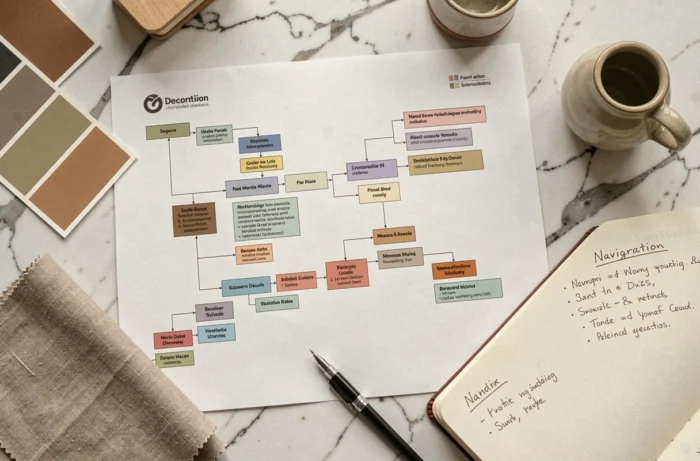
HTML sitemap or XML: which to consult to explore a decor site
The confusion between HTML sitemap and XML sitemap persists. For a user wanting to explore a decor site, the two formats serve different purposes.
The XML sitemap is intended for bots. It lists URLs with their technical metadata (priority, modification frequency, date). This is the file to consult for a quick audit or to understand a site’s indexing coverage.
The HTML sitemap is a page of the site, accessible to visitors, that presents the structure in the form of clickable links. On a decor site, this page facilitates access to buried sections: maintenance guides, material pages, archived collections. When a decor site offers both formats, the XML provides the technical view, while the HTML offers the editorial view.
When the HTML sitemap surpasses the navigation menu
Menus on decor sites prioritize commercial highlighting: current collections, promotions, new arrivals. Background pages (style guides, material comparisons, long-tail SEO content) often disappear from the main menu after a few weeks.
The HTML sitemap retains these links. For a visitor searching for specific content on a style or decoration technique, the HTML sitemap remains the most reliable entry point to older content. Search engines themselves use this page as a complementary discovery tool when the site’s internal linking presents gaps.
Frequency of sitemap updates and freshness of decor content
A sitemap that is not updated regularly loses its signaling function for engines. On a decor site, content evolves with collections, seasons, and trends. If the sitemap displays lastmod dates that have been static for several months, Google gradually reduces the crawl frequency allocated to the site.
We observe that decor sites that update their sitemap with each publication or modification of a product sheet achieve faster indexing of their new content. The lastmod tag is not a ranking signal, but it directly influences the priority of exploration by bots.
The sitemap of a decor site is not a file to be generated once and then forgotten. It is a living document that reflects the site’s editorial dynamics, and regular consultation, whether you are the site owner or a savvy visitor, provides a more accurate reading of the actual extent of the content offered.