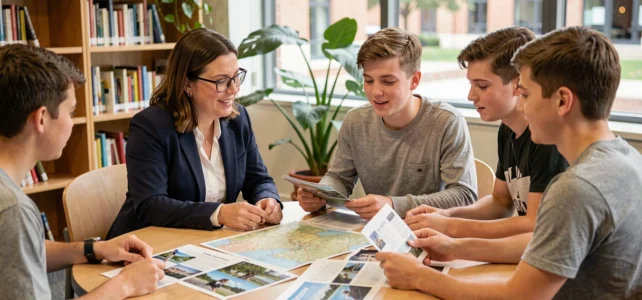
A teacher organizing their first school trip often spends more time searching for the right administrative forms than designing the educational program. The training dedicated to organizing school trips exists to reverse this ratio. It covers the regulatory framework, budget management, and logistical coordination, three skills that initial teacher training hardly addresses.
Regulatory framework for school trips: what training should prioritize
The circular MENE2310475C of June 29, 2023, sets a clear objective: every student must benefit from at least one school trip during their compulsory education. This is no longer a matter of optional bonus, but of institutional commitment. Recent training incorporates this evolution because it changes the role of the organizing teacher.
Specifically, a circular from July 16, 2024, clarifies the boundary between mandatory outings and optional trips. An outing is mandatory when it takes place during the teaching hours scheduled in the timetable. Trips with overnight stays (discovery classes, language stays) remain optional, and in this case, school insurance is required for each participating student.
This distinction has direct consequences on the preparation of the file. One must be able to qualify their project from the start, anticipate the insurance certificates, and especially explain to families what the optional status implies (possibility of refusal, care for the non-participating student). Trainings that do not address this administrative mechanism leave a significant blind spot, as several pieces of information available on Partir en Classe detail these obligations by type of stay.
School trip training: budgetary skills and financial setup
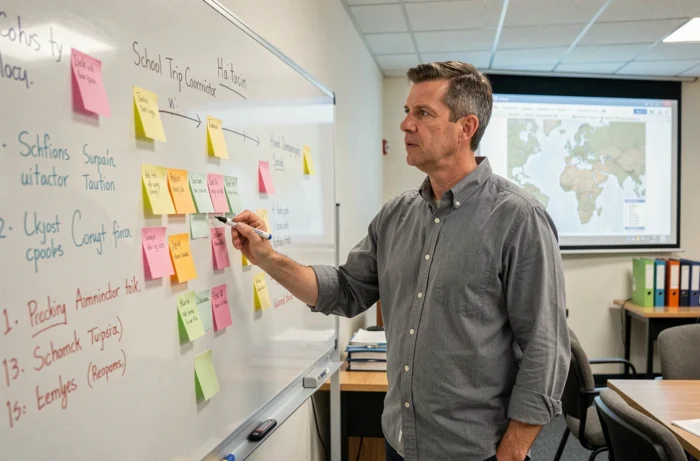
The position that causes the most project failures is not pedagogy, but the budget. Trips are often abandoned because the teacher underestimated a transportation cost or did not anticipate the collection methods from families.
A solid training dedicates a significant portion to financial setup. This aspect covers several areas that practice alone does not suffice to master:
- Constructing a realistic budget forecast, distinguishing between non-negotiable items (transport, accommodation, insurance) and adjustable items (activities, on-site catering)
- Mobilizable funding sources: family contributions, grants from local authorities, social funds of the institution for scholarship students, fundraising activities like bake sales or raffles
- Accounting management of the trip within the institution, which involves administration and often underestimated processing times
- Pricing policy towards families, which must take into account the principle of free education for mandatory outings
Knowing how to present a clear budget to the head of the institution and to parents is a skill that most teachers acquire on the job, after an initial failure. Trainings help avoid this painful trial and error.
The trap of a single quote
Feedback varies on this point, but a common reflex among novice organizers is to request only one quote from a specialized organization. This leaves them without a point of comparison for transport or accommodation. Field trainings systematically recommend soliciting at least three providers, combining a school travel organization, a direct accommodation provider, and a mixed solution.
Safety and supervision: the training aspect that teachers dread the most
The legal responsibility of the accompanying teacher is a topic that generates a lot of anxiety. Trainings address this point by distinguishing two levels: the responsibility of the organization beforehand and the responsibility of supervision during the stay.
Beforehand, parental authorizations, health forms, identity documents for a trip abroad, and the list of supervisors are prepared. The supervision ratio depends on the school level and the type of outing. For a stay in France with overnight accommodation in elementary school, regulations set precise thresholds that each training must detail.
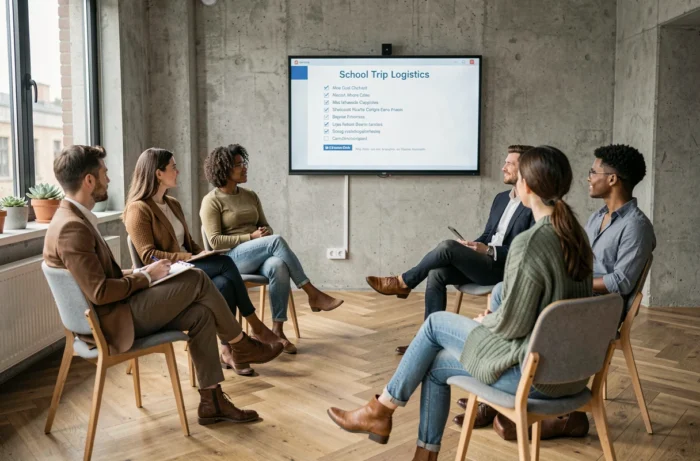
During the trip, the training teaches how to anticipate crisis situations. What do we do if a student needs to be hospitalized abroad? Who informs the family, and in what order? These protocols cannot be improvised on the day of the trip.
The role of volunteer chaperones
It is often forgotten that accompanying parents do not have the same status as teachers. A volunteer chaperone can never be solely responsible for a group of students. Trainings emphasize this point, as the field shows that the temptation to “distribute” students among adults for flexibility creates legally fragile situations.
Educational project of the school trip: structuring before booking
A common pitfall is to book transport and accommodation before finalizing the educational project. This results in a program built around logistical constraints rather than learning objectives.
Successful trainings start from the school curriculum. First, the targeted skills are identified (history, science, foreign languages), then the destination and activities that serve these objectives are sought. This reverse sequencing changes the quality of the file presented to the board of directors.
- A trip to a coastal region can serve a natural science project on coastal ecosystems
- A stay in a European city can link history, language, and civic education around a common thread
- A discovery class in a rural area allows for working on geography and sustainable development with local speakers
A well-constructed educational project also facilitates communication with families. When we explain why we are going and what the students will learn, the parents’ approval rate increases significantly, and questions about cost become secondary.
Training in organizing school trips is not just an administrative checklist. It structures a comprehensive approach, from the regulatory framework to the educational assessment upon return. Teachers who train before their first project gain several weeks of preparation and avoid mistakes that compromise the trip.