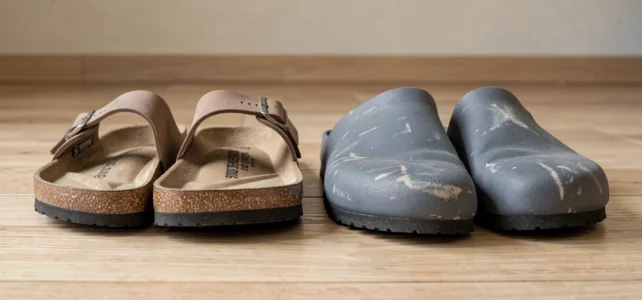
The anatomical cork-latex insole from Birkenstock and the soft Billowy insole do not engage the same structures of the foot. Choosing between these two brands without considering foot morphology ignores the main selection criterion. Here, we detail the technical points that truly separate these two approaches to comfort.
Birkenstock Anatomical Insole and Molded Arch: Documented Biomechanical Limits
The cork arch of Birkenstock conforms to the foot’s arch according to a standardized profile. This design choice suits some users, but the work of British podiatrist Dr. Stewart Branthwaite shows that the population divides into three groups regarding this type of insole: those who gain a net benefit in stability, those who perceive no difference, and those who experience marked discomfort, described as the sensation of having a thorn in their shoe.
Two scenarios pose problems. Feet with a very high arch can develop irritation of the Achilles tendon, as the heel-to-toe drop is insufficient on classic models like the Arizona. Very flat or very rigid feet, on the other hand, poorly tolerate the curvature of the molded arch, which becomes aggressive instead of supportive.
We recommend consulting the reviews on Billowy and Birkenstock published by long-term wearers before any purchase, as the feel during fitting does not always reflect the insole’s behavior after several weeks.

Billowy Construction: Flexibility and Bending, for What Type of Foot?
Billowy, a Spanish brand positioned in the children’s and young adult segment, adopts an opposite philosophy. The insole prioritizes flexibility and supports the natural rolling of the step. The material, lighter than cork, offers less structure but more freedom of movement.
A growing foot does not react like a stabilized adult foot. The flexibility of the Billowy insole follows the podiatric logic that a child needs a shoe that does not constrain developing musculature. In adults, this same flexibility can translate into a lack of support during long days of walking.
The point of caution concerns the arch: Billowy models do not provide arch support comparable to that of Birkenstock. For an adult suffering from plantar fasciitis or metatarsalgia, this lack of relief can exacerbate muscle fatigue by the end of the day.
When Flexibility Becomes an Asset
On soft ground (sand, grass), a flexible insole absorbs irregularities better than a rigid cork insole. For casual summer use of a few hours, the Billowy construction fulfills its role without overloading the foot. The problem arises beyond four to five hours of continuous wear on hard ground.
Birkenstock Arizona, Boston, Madrid: Which Model According to Foot Pathology
Birkenstock models are not equal from a biomechanical perspective. The difference lies in foot coverage and lateral support.
- The Arizona two-strap model leaves the heel free, which can be problematic for individuals prone to ankle instability or excessive pronation.
- The Boston, a closed-toe clog, offers better overall support and limits micro-slipping of the foot forward, reducing the strain on clawed toes.
- The Madrid, with a single strap, suits wide feet but provides almost no transverse support, making it unsuitable for long walks.
The choice of model is as important as the choice of brand. An ill-fitting Arizona causes more harm than a well-sized soft sandal.
Strap Adjustment, an Underestimated Parameter
An overly tight strap compresses the top of the foot and disrupts venous circulation. A strap that is too loose forces the toes to grip to hold the sandal, excessively straining the flexors. We observe that most complaints related to Birkenstock comfort stem from inadequate adjustment rather than a design flaw.
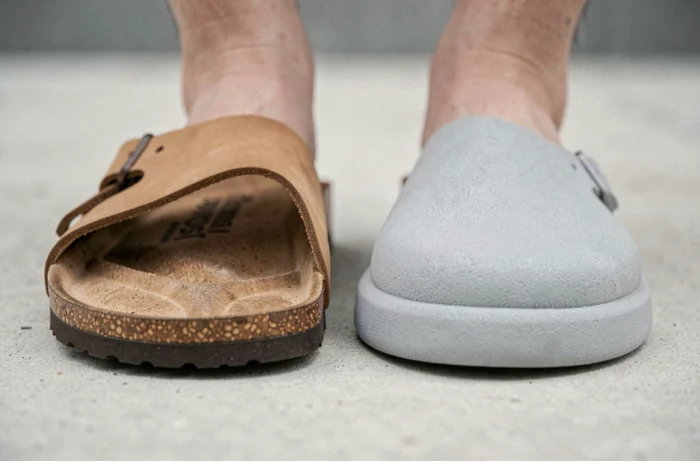
Selection Criteria Between Billowy and Birkenstock According to Podiatric Profile
The question is not which brand is “better,” but which one corresponds to the morphology and actual use of the wearer. Here are the discriminating criteria:
- High or normal arch: Birkenstock (Boston or Arizona model) provides structural support that Billowy does not offer.
- Rigid flat foot: neither is suitable without an orthopedic insole. The Birkenstock arch may even exacerbate discomfort.
- Growing child: Billowy, whose flexibility respects the developing musculature of the foot.
- Prolonged wear on hard ground (more than four hours): Birkenstock with properly adjusted straps.
- Occasional summer use: Billowy offers a more coherent comfort-to-price ratio for a few hours of wear.
The material of the upper also plays a role. Birkenstock models in natural leather soften over time and conform to the foot, while synthetic versions retain their initial rigidity. In Billowy, the materials remain flexible from the first wear but age less well over time.
Choosing between these two brands without knowing one’s foot type is akin to buying glasses without a prescription. A quick podiatric assessment guides the choice much more effectively than an online comparison. For intermediate profiles, alternating between the two types of insoles according to activity remains the most reasonable strategy.