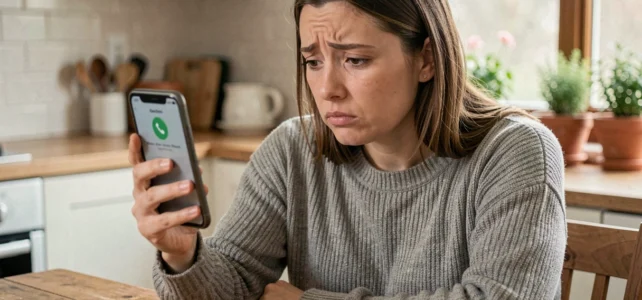
Receiving a call from an unknown number on your mobile has become commonplace. Since August 11, 2026, the French legal framework has changed: telemarketing is now prohibited by default, unless there is prior consent from the consumer. The Bloctel system has disappeared as of that same date.
Despite this tightening, unidentified calls persist, whether they come from professionals hiding their line, illegal telemarketers, or ordinary individuals. Understanding the tools available to trace the source of these calls remains a concrete question for most smartphone users.
What the phone doesn’t show you: CLIR and network protocols
When a call appears as “private number” or “blocked number,” it is the CLIR (Calling Line Identification Restriction) protocol at work. The caller activates this feature from their phone settings or through their operator, and the network removes the number display on the recipient’s side.
The key point to remember: the number still exists in the operator’s logs, even if it does not appear on your screen. The restriction only affects the display, not the technical transmission of the number through the network. It is this distinction that makes identification possible in certain cases, particularly under judicial requisition.
When you seek to identify an unknown number, the first step is to distinguish between two very different situations: a number that displays but you do not recognize, and a number that is intentionally blocked. The tools and chances of success are not the same.

Native filtering on iPhone and Android: recent settings
Mobile operating systems have significantly strengthened their filtering functions in recent years. On iOS 26, Apple now offers a “Filter Unknown Callers” menu with several response levels: the phone can send the call directly to voicemail, or ask the caller to identify themselves verbally before ringing the phone.
This voice filtering is a significant new feature. The caller hears an automated message inviting them to state their identity. If the voice response matches a known contact or if the user decides to accept, the call goes through. Otherwise, it is redirected without a sound notification.
On the Android side: Google’s call filter
On Pixel phones and some Samsung devices, Google integrates a filtering assistant that answers the caller and transcribes in real-time what they say. The user sees the text displayed on the screen and decides whether to take the call or not.
The available data does not allow us to conclude that these native filters actually identify the caller. They protect against noise nuisance, but do not reveal the blocked number behind the call. For that, other tools are needed.
Identification apps: TrueCaller, Hiya, and the limits of the collaborative model
Several specialized applications operate on a collaborative database principle: each user contributes (voluntarily or not) by sharing their contacts, and the app cross-references this data to associate a name with an incoming number.
- TrueCaller claims to have the largest global database. The app has recorded several billion identified spam calls in recent years, with particularly dense coverage in Asia and Europe.
- Hiya operates on a similar model but places more emphasis on spam detection than on name identification.
- More recent alternatives like Hangup, developed by NordVPN, focus on detecting fraudulent calls with a “privacy” angle, promising not to scrape the contact list.
The underlying problem: these applications only work if the number is in their database. A number blocked via CLIR completely escapes them. They are effective against displayed but unrecognized numbers (telemarketers, spam), much less so against calls that are intentionally anonymized.
The issue of personal data
The collaborative model of TrueCaller raises a question that competing articles rarely address head-on. When you install the app and agree to share your contacts, the numbers of your contacts (who did not ask for this) end up indexed in a database accessible to millions of users. In Europe, this operation comes into direct tension with GDPR.
Field reports vary on this point: some users find that their number appears on TrueCaller even though they have never installed the app. The only explanation is that one of their contacts did it on their behalf.

Increased penalties and reporting: the new framework since August 2026
The shift to a consent-based calling regime in France has changed the game for reporting unsolicited calls. Fines can reach 75,000 euros per call for individuals and 375,000 euros for legal entities in cases of illegal telemarketing. These amounts represent a significant shift compared to the previous system.
The disappearance of Bloctel leaves a gap in habits. Until now, the standard recommendation was to register on this opposition list. Now, it is the opposite: any unsolicited commercial call is illegal by default. The consumer no longer has to prove that they have registered somewhere.
In practice, reporting is done through 33 700 (via SMS) or through the online platform of the same name. For cases of proven harassment, filing a complaint remains the only way for law enforcement to obtain a requisition from the operator and lift the anonymity of the blocked number.
What to do concretely in the face of persistent blocked calls
The 3131 service, offered by most French operators, allows you to listen to the last received call and, in some cases, obtain the associated number. However, its effectiveness on calls blocked via CLIR remains limited: the number is not always retrieved.
- Activate the native filtering of your system (iOS or Android) to redirect unknown calls to voicemail.
- Install an identification app only if you accept the compromise on personal data.
- Systematically report suspicious displayed numbers to 33 700.
- In cases of repeated and threatening calls, keep precise dates and times before filing a complaint.
No public tool guarantees the identification of a voluntarily blocked number. The French legal framework reserves this possibility for judicial authorities, upon motivated request. For unblocked commercial calls, collaborative apps and the new penalty regime offer more concrete levers than before.