Brittany decoration is not limited to marine stripes and seaside objects. The visual vocabulary of Brittany is based on geological materials (granite, schist, slate), locally woven textiles (linen, wool), and a color palette dictated by the real landscape: moors, cliffs, changing skies. Starting from these fundamentals allows for a coherent interior, rooted in a territory, without falling into postcard decor.
Brittany’s mineral palette: colors that replace navy blue
The 2025-2026 decor trend for Brittany-inspired interiors moves away from classic seaside codes. Grayed blues (slate, night), off-whites, granite grays, and muted greens now form the basis of a mineral palette inspired by the Breton landscape.
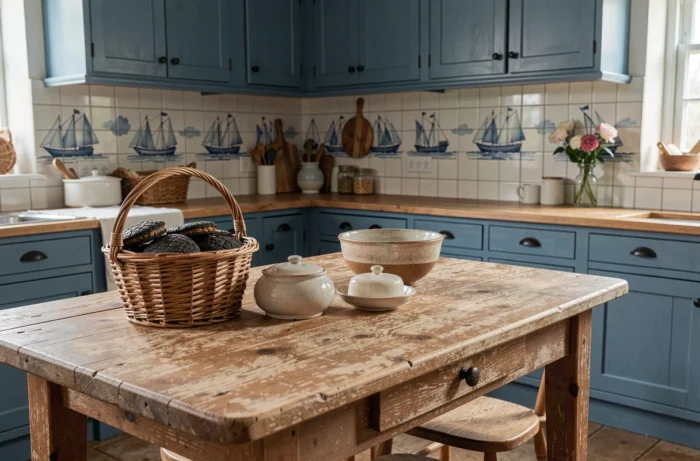
Slate blue, for example, works well on an accent wall as well as on painted wooden furniture. Paired with sandy beige and natural linen, it evokes the coast without literally citing it.
To find objects and furniture that fit this approach, the home universe on Terre de Breizh gathers pieces designed for this style. Heather green, drawn from gorse and heather, adds a vegetal depth that blue alone does not produce. Pairing it with light raw wood (oak, beech) creates a soft contrast, far removed from the overused blue-white duo.
Granite, raw wood, and linen: materials for sustainable Breton decoration
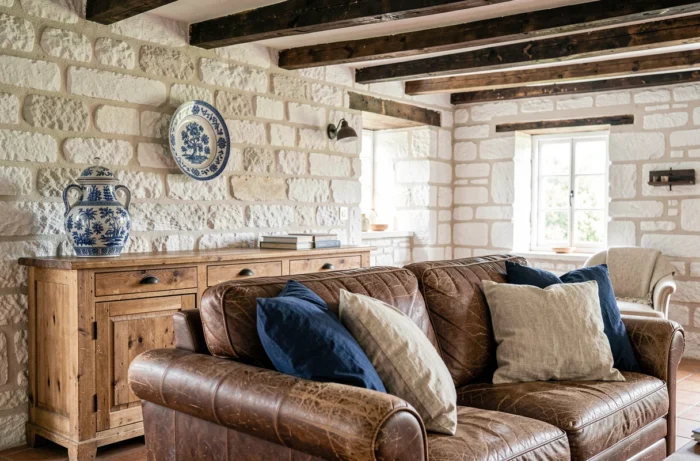
Granite is the most immediate marker of Breton architecture. In interior decoration, it is not about building a stone wall in your living room, but about preserving or revealing its presence when it exists.
Preserving exposed stone
In an old house, stripping a coating to reveal the original granite radically transforms a room. The lime joint, lighter than cement, highlights each block without darkening the space. A simple matte water repellent protects the stone without polishing it.
For recent constructions or apartments without stone, a natural schist cladding on a portion of the wall (fireplace, entrance) is enough to establish the Breton mineral vocabulary.
Veined wood and linen textiles
The wood used in traditional Breton interiors is rarely smooth. Exposed oak beams, chestnut furniture, aged floors: texture matters as much as the type of wood. Keeping the grain visible, applying a matte oil rather than a glossy varnish, preserving knots and irregularities—this is what distinguishes a Breton piece from simply rustic furniture.
Raw linen, historically grown in Brittany, remains the most coherent textile for curtains, cushions, and tablecloths. Its slightly crumpled texture absorbs natural light, often changing in interiors exposed to the west.
Natural light and layout: adapting the space to the Breton climate
Brittany’s brightness varies greatly with the hours and seasons. An interior that works in this region must take this into account beyond just color choices.
- Favor light walls (off-white, pearl gray) in north or west-facing rooms to compensate for the low light, while reserving deep shades (night blue, forest green) for walls that receive direct light
- Place mirrors opposite windows to redistribute light in deep rooms, common in Breton longhouses
- Opt for lighting fixtures made from natural materials (rattan, turned wood, matte ceramic) that diffuse warm light without creating a harsh contrast with the gray outside light
The layout of a longhouse imposes specific constraints: rooms in a row, shallow depth, thick walls that reduce floor space. Keeping circulation clear and limiting bulky furniture in passageways avoids a corridor effect.
Breton decorative objects and details: what works, what is outdated
The line between an embraced regional reference and a tourist cliché often hinges on a single criterion: does the object have a function or a story, or does it serve only as a signal?
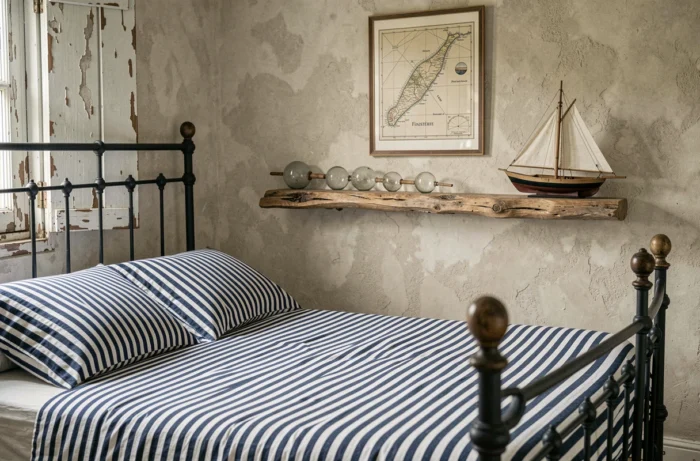
An old Quimper faience, a name bowl in stoneware, a model ship built by a local workshop tells a story. A resin lighthouse bought at a supermarket tells nothing.
What anchors an interior without freezing it
- Handcrafted Breton tableware (stoneware, faience) used daily and not stored away: it brings color and texture to an open shelf or a sideboard
- Textiles woven in Brittany (wool blankets, linen dish towels) that age well and develop a patina over time
- Lighting fixtures in ceramic or turned wood, made by local artisans, that advantageously replace industrial pendants
- Frames and engravings depicting the Breton coast or countryside, provided that original works or quality reproductions are chosen rather than generic posters
An authentic Breton interior mixes eras. An antique chestnut piece coexists with a contemporary sofa, a handcrafted pottery sits next to a designer lamp. Cohesion comes from materials and the palette, not from a uniformly applied theme.
Energy renovation and Breton houses: the often-overlooked lever
Modernizing a stone house without altering its thick walls requires choosing insulators compatible with old buildings. Granite walls breathe and naturally regulate humidity: a waterproof synthetic insulator traps water vapor and can degrade the stone in a few years.
Breathable insulators (wood fiber, lime-hemp, cork) preserve hygrometric exchanges while improving thermal comfort. This technical choice also has a decorative impact: a raw lime-hemp coating offers a soft, slightly textured finish that naturally harmonizes with stone and wood.
National energy renovation aids, notably MaPrimeRénov, apply in Brittany and can finance a significant part of these insulation works, including on old buildings. Combining energy renovation and decorative renovation allows for rethinking an entire room in a single intervention.
The most lasting Breton touch in an interior comes neither from an object nor from an isolated color. It lies in the harmony between the building materials, the light of the place, and decorative choices that extend the landscape rather than mimic it.