
Since 2024, the majority of French travelers who need a visa for a tourist or business stay can apply without going to an embassy or visa center. The electronic visa (e-visa) relies on an online form, a digital payment, and a response sent by email, often within a few days. The mechanism seems simple, but the differences between countries, documentary pitfalls, and recent regulatory changes deserve attention.
What changes with the digitization of Schengen visas and the deployment of ETIAS
The European Union has initiated a complete digitization of the Schengen visa procedure, aiming for a full rollout of the digital visa entirely online by 2026, followed by a five-year transition for all member states to use a common application platform. Meanwhile, the Entry/Exit System (EES) and the ETIAS travel authorization for visa-exempt travelers change the game: the electronic authorization application becomes a systematic step before departure.
For third-country nationals, this means that a paper file submitted at the consulate will gradually be replaced by a centralized form. For travelers usually exempt from Schengen visas, ETIAS imposes a new, fee-based requirement to anticipate before boarding. The two systems will coexist for several years, which may create confusion when preparing a trip.
This trend goes beyond Europe. South Africa has implemented its Electronic Travel Authorization system for all eligible countries. Canada, the United Kingdom, and Mauritius are following similar paths. It is possible, for many destinations, to obtain an internet visa on 123 Voyages by entering one’s nationality and destination country to check eligibility before any steps are taken.
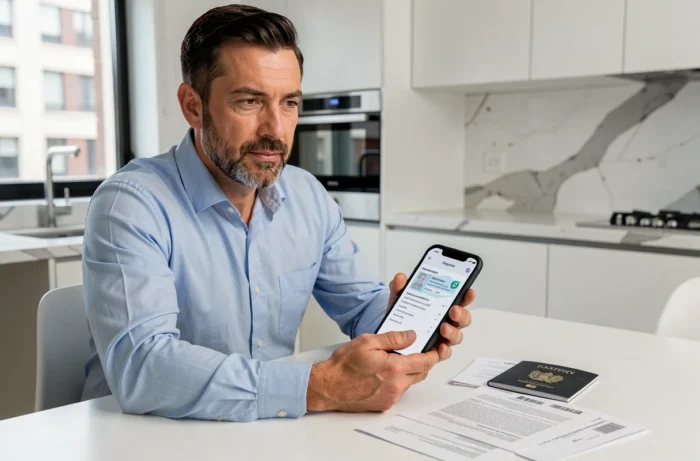
e-visa form: concrete blocking points to anticipate
The application process generally follows the same pattern, regardless of the destination country: fill out a form, upload digitized documents, pay consular fees online, and then wait for validation by email. The apparent simplicity masks details that can lead to refusals or delays.
Required documents and formats
Each country sets its own specifications. A passport valid for at least six months after the return date is the almost universal rule. The ID photo, however, often must meet specific dimensions and background requirements that vary from one portal to another.
- The scan of the passport must be readable, in color, with the double page (photo and personal information) visible without cuts. A file that is too compressed or a photo taken with a phone in poor lighting conditions can lead to automatic rejection.
- The digital ID photo sometimes follows a square format, sometimes a 2:3 ratio, with a maximum weight that differs by platform. Some portals (India, Turkey) have an integrated cropping tool, while others do not.
- Supplementary documents (hotel reservation, return ticket, travel insurance certificate) are required by some countries at the time of the online application, while others only request them at the border.
Actual timelines and cases of prolonged verification
Official platforms announce timelines ranging from a few hours to several business days. In practice, applications remain stuck at the “waiting verification” stage for weeks, as travelers regularly report for Indonesia or Namibia on specialized forums. Field reports vary on this point: some receive their e-visa in less than twenty-four hours, while others wait well beyond the displayed timeline without explanation.
Launching the application at least three weeks before departure remains the most reliable precaution, even when the site announces processing within a few days.
Official and intermediary platforms: knowing where to submit your application
A point rarely clarified by competing guides is the distinction between the official portal of the government of the targeted country and private intermediary sites. Both allow obtaining an e-visa, but the differences in cost and responsibility are significant.
The official portal only applies the consular fees set by the state. An intermediary adds service fees, sometimes comparable to the visa itself. In return, some intermediaries offer a preliminary verification of the file and follow-up in case of problems. Online reviews of these services are very mixed: high ratings coexist with complaints about unmet timelines or unreachable customer service.
To identify the official site, the safest method remains to consult the website of the embassy of the concerned country in France. The URL of the e-visa portal is systematically listed there. Official sites use a government domain (.gov, .gouv, or local equivalent), which serves as a simple marker.

e-visa refusals: common reasons and limited recourse
An electronic visa refusal is notified by email, often without detailed reasoning. Available data on Schengen visa refusals show that the most common reasons are related to incomplete documents, doubts about the actual purpose of the stay, or lack of proof of sufficient resources.
- An inconsistency between the flight ticket dates and those declared in the form frequently triggers a rejection.
- A passport with less than the required validity remaining leads to automatic refusal, with no possibility of post-correction.
- The absence of travel insurance covering the destination territory, when required, constitutes a documented reason for refusal.
In case of rejection, most e-visa portals do not provide for a formal appeal procedure. The only option is generally to submit a new application, with new fees. Checking each field before validation is not a trivial piece of advice: it is the only real protection against an avoidable refusal.
The gradual shift to fully digital simplifies access to visas for the majority of travelers, but it shifts the responsibility of the file onto the applicant. No clerk will point out a blurry photo or an incorrect date before submission. Carefulness when filling out the form remains the most significant factor affecting the final outcome.