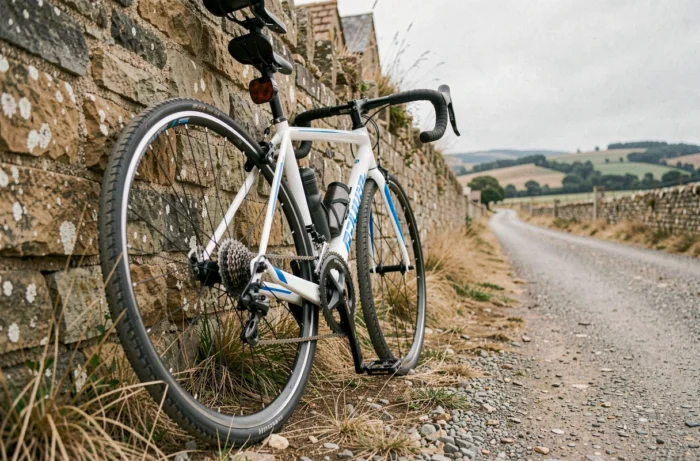
The Triban RC120 has occupied the entry-level road segment at Decathlon for several years, with a price positioning that makes it hard to ignore. Aluminum 6061 T6 frame, carbon fork, mechanical disc brakes, and Microshift transmission: the technical specifications check all the boxes expected at this price point. The real question is not whether it rides well, but where it stands against current alternatives based on criteria that traditional buying guides overlook.
Frame stiffness and dynamic behavior of the RC120
The aluminum 6061 T6 frame of the RC120 offers decent lateral stiffness for a bike in this segment, but its seat tube and rear stays are designed more for comfort than for acceleration. Coming out of a corner or during a strong acceleration, a measurable flex is noticeable at the bottom bracket. This is not a design flaw: it is a deliberate trade-off.
The carbon fork absorbs high-frequency vibrations well, which explains the feeling of smoothness on rough roads. However, it transmits little feedback through the handlebars. A cyclist used to rigid aluminum forks will find the front end less precise at high speeds.
The RC120 prioritizes stability at low and medium speeds, a coherent choice for a bike intended for discovery rides and commuting. Road.cc notes that it is difficult to find better at this price if comfort and stability are what you’re after. Our comparison of the Triban RC120 against its direct competitors details these behavioral differences frame by frame.

Microshift transmission vs Shimano Claris: the real technical gap
The RC120 features a Microshift 8-speed group. Mainstream articles simply mention “2×8 transmission,” without specifying what this means in real-world use. The difference with a Shimano Claris, found on competitors at the same price, is not just about the number of gears.
The indexing precision of Microshift deteriorates more quickly with cable wear. After a few thousand kilometers, gear shifts under load become imprecise and require more frequent adjustments of the rear derailleur. Shimano Claris tolerates residual tension better and maintains crisp indexing for longer.
- Microshift: separate brake lever and derailleur lever on some versions, less intuitive ergonomics during acceleration
- Shimano Claris: integrated STI controls, gear shifts from the hoods without repositioning the hand
- Replacement cost: Microshift parts are cheaper individually, but availability in physical stores is lower than that of the Shimano network
Over two years of regular use, a Claris group retains its shifting quality better. For a cyclist who rides three times a week, this difference becomes noticeable by the second season.
RC120 against recent allroad bikes: the tire and clearance question
The positioning of the RC120 has changed without its technical specifications evolving. By 2026, several entry-level allroad or gravel frames accept tires of 40 mm and more, while offering a road geometry suitable for asphalt.
The RC120 accepts tires up to about 32 mm, which limits versatility on paths or damaged roads. A cyclist considering mixed outings (road + stabilized path) quickly finds themselves constrained by this clearance. Competing allroad models, even at a similar price, often offer a tire clearance greater than 38 mm.
This is not trivial. A wider tire run at moderate pressure partly compensates for the lack of suspension and provides superior grip on varied surfaces. The RC120 remains a pure road bike in its design, and this choice no longer suits all the uses for which it is recommended in general guides.

Mechanical disc brakes: an asset or compromise in this price segment
The mechanical disc brakes of the RC120 provide a clear advantage in rainy weather compared to rim brakes. The bite remains predictable and the modulation is adequate for non-sporting use.
However, a mechanical disc requires more frequent caliper adjustments than a hydraulic one. Asymmetric wear of the pads is common and causes unwanted rubbing if alignment is not checked regularly. On a bike intended for commuting where braking is frequent, this maintenance issue arises every few weeks.
Direct competitors around the same price sometimes offer hydraulic brakes, which eliminates this constraint. Upgrading from mechanical to hydraulic on the RC120 is technically possible but involves changing levers and hoses, at a cost approaching that of a complete bike upgrade on the second-hand market.
Triban repositioning and buying prospects in 2026
Since 2024, the Triban brand has been absorbed into the Decathlon ecosystem in favor of Btwin, Van Rysel, and Rockrider. The RC120 remains in the catalog, but the upgrade path now goes through Van Rysel (EDR and NCR ranges). This reorganization has a concrete consequence: specific parts branded Triban will not be available indefinitely in after-sales service.
For a new purchase, the RC120 is still priced around 550 euros. At this price, we recommend checking two points before finalizing:
- The availability of your size in-store, as stocks vary greatly depending on the season and colors
- The existence of a recent Van Rysel or Btwin model at the same price, which may incorporate geometry or transmission updates absent from the RC120
- The second-hand market, where RC500s equipped with Shimano Sora are regularly found for a comparable budget
The RC120 remains a reliable and well-finished bike for its price. Its frame handles the kilometers without complaint, and the carbon fork makes a real difference in comfort. But the competition has progressed faster than it has, and comparing it only to the old RC100 is no longer sufficient to justify its purchase without examining current alternatives.