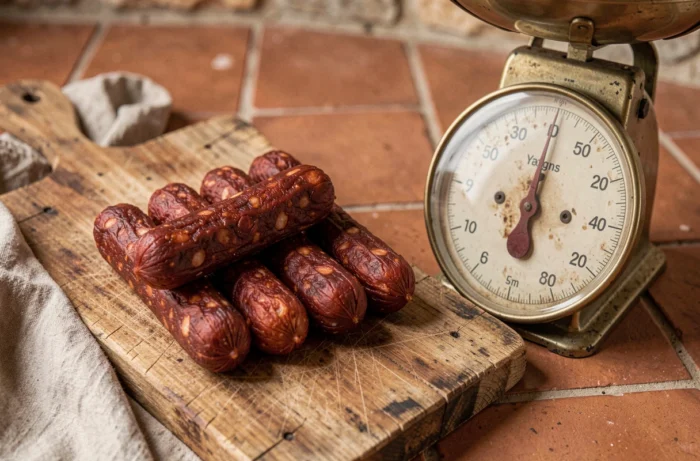
The weight of a merguez sausage varies depending on whether it comes from an artisanal workshop or an industrial line. This difference, sometimes as much as double, changes the game when estimating quantities for a barbecue. The usual ranges cited are between 50 and 90 grams per piece, but this figure masks significant variations related to the composition, the type of casing used, and the fat content of the mixture.
Beef-lamb, pork, or poultry merguez: weight varies with the recipe
Two merguez of the same length do not necessarily weigh the same. The density of the mixture directly depends on the lean meat/fat ratio and the type of protein used.
A standard beef-lamb merguez in supermarkets has about 28 to 29 g of fat per 100 g. This fat content makes it denser than a poultry version, which has around 15 g of fat per 100 g. With the same casing format, the poultry merguez is therefore lighter.
Pork merguez fall in between, with about 19 g of fat per 100 g. Some organic beef-lamb references without allergens go even lower, around 11 g of fat per 100 g, which significantly alters the final weight of each piece.
Knowing the weight of a merguez based on its composition helps adjust quantities before ordering from the butcher or in the self-service aisle.

Raw merguez weight and loss during barbecue cooking
Barbecue cooking melts some of the fat and evaporates the water contained in the mixture. A standard beef-lamb merguez loses more mass than a poultry merguez, precisely because its initial fat content is higher.
In practical terms, a raw merguez weighing 80 g will not weigh the same on the plate. The weight loss during cooking depends on the fat and the time on the grill. The longer the merguez stays on hot coals, the more it reduces.
This is why cooking recommendations emphasize not piercing the casing: puncturing the skin accelerates the loss of juice and fat, which dries out the merguez and further reduces its final weight.
To estimate the actual portion on the plate, one must therefore think in terms of raw weight and accept that a significant portion will disappear during grilling.
Calories and salt by type of merguez: comparative table
The weight alone is not enough for accurate dosing. Two 80 g merguez do not provide the same caloric load or salt level depending on their composition. Here is a comparison based on nutritional data from products sold in supermarkets.
| Type of merguez | Calories (per 100 g) | Fat | Salt |
|---|---|---|---|
| Standard beef-lamb | about 318 to 324 kcal | 28-29 g | more than 2 g |
| Pork | about 244 kcal | 19 g | about 1.8 g |
| Poultry | about 199 kcal | 15 g | variable |
| Organic beef-lamb without allergens | about 176 kcal | 11 g | about 2.2 g |
This table shows that organic merguez are not systematically lower in salt. Some references show a salt content of 2.2 g per 100 g, which is more than conventional pork merguez. Reading the label remains the only reliable way to compare.
Vegan merguez: a unique nutritional profile
Vegan merguez made from seitan hover around 223 kcal per 100 g with 12 g of fat. Their weight per piece entirely depends on the manufacturer, without constraints related to the size of the natural casing. Field feedback varies on this point: some brands offer sizes close to 100 g, while others provide significantly smaller pieces.
Portion size per person based on the meal context
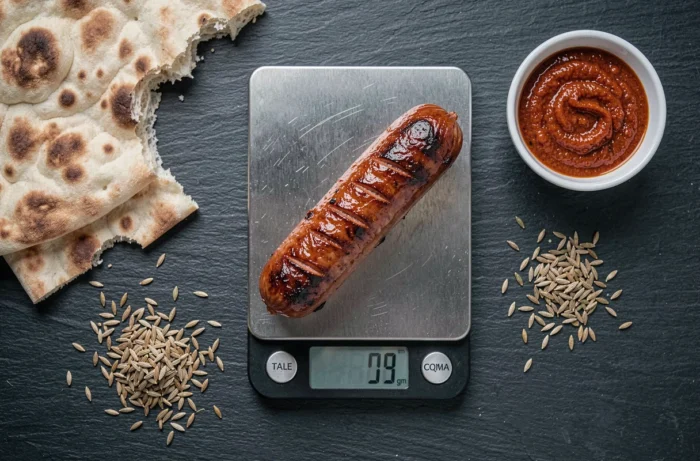
The portion size depends less on the number of merguez than on the total weight of meat per guest. Commonly used benchmarks distinguish two situations.
- Mixed barbecue with other meats, salads, and sides: plan for about 150 to 180 g of raw merguez per adult, or two to three pieces depending on their size.
- Merguez as a main dish (couscous, sandwich, full plate): expect 200 to 250 g per adult, or three to four pieces of standard size.
- For a child, a portion of 80 g is usually sufficient, which corresponds to one piece of standard size.
These benchmarks assume merguez weighing 70 to 90 g each. If you buy thicker artisanal merguez, which can approach 100 g, reduce the number of pieces accordingly.
Read the label before buying: net weight and number of pieces
The trays sold in supermarkets indicate a total net weight, but rarely the unit weight of each merguez. A tray of 800 g containing 12 pieces gives merguez of about 65 to 70 g each. The same brand in a pack of 20 pieces for 1.6 kg offers pieces of about 80 g.
For precise dosing, divide the net weight displayed by the number of pieces indicated on the packaging. This simple calculation avoids unpleasant surprises at serving time.
- Check the salt content: beyond 2 g per 100 g, adjusting the quantity of merguez per person may make sense, especially for guests monitoring their sodium intake.
- Compare the fat content: it directly influences weight loss during cooking and the final caloric value.
- Prefer labels that detail the meat/fat ratio: a minimum of 15% fat ensures a juicy merguez without excess.
The weight of a merguez is not just a logistical figure for filling plates. It conditions cooking, nutritional intake, and budget. Starting from the actual unit weight rather than an approximate number of pieces remains the most reliable method to avoid waste as well as insufficient portions.