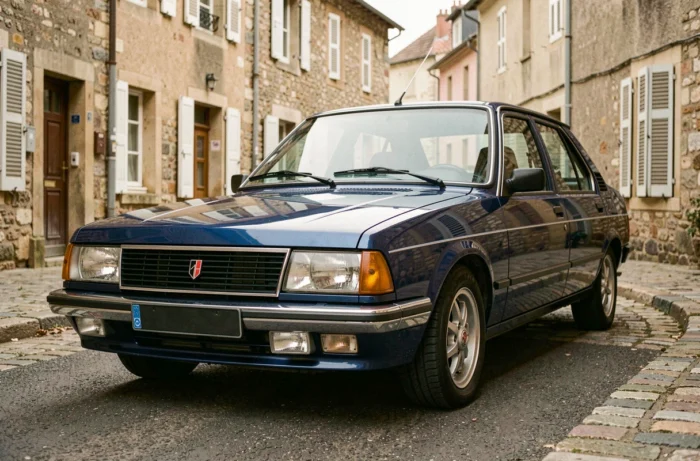
The Renault 30 is often summed up by its PRV V6 and a lukewarm commercial reception. Few people know that the initial project planned for a V8 engine. This change of direction, dictated by the oil shock and industrial decisions, shaped the entire technical identity of this large French sedan produced from 1975 to 1983.
Renault Project H: the V8 abandoned before the Renault 30
Even before the Renault 30 came to life, another vehicle occupied the design offices. The Renault Project H, developed between 1966 and 1967, was intended to propel the diamond brand into the premium segment, facing the Citroën DS.
This prototype featured a 3.5-liter V8 with two double-barrel carburetors, paired with a four-speed manual transmission with an optional five-speed. The project was conducted jointly with Peugeot, foreshadowing the future industrial alliance around the PRV engine.
Why was this V8 never produced in series? The project was canceled in early 1967 for economic reasons. Only one prototype was built, and it is now preserved by Renault Classic. To delve deeper into the technical specifications and power of the Renault 30 V8, this transition from V8 to V6 is the main key to understanding.
The oil crisis of 1973 ultimately rendered the V8 unsuitable for the European market. Renault, Peugeot, and Volvo then pooled their resources to design a more economical engine, but one that still bore traces of its eight-cylinder ancestor.
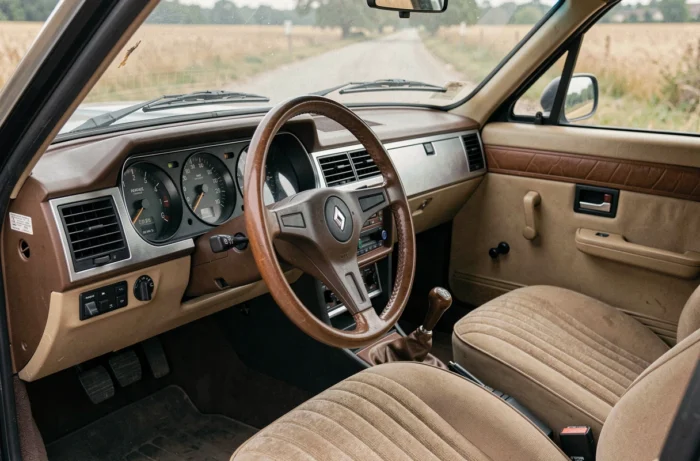
PRV V6 Engine: a 90° V8 architecture in a six-cylinder block
The PRV V6 (Peugeot-Renault-Volvo) that equips the Renault 30 is not an engine designed from scratch. Its 90° architecture comes directly from the aborted V8. In a classic V6, the angle between the two rows of cylinders is usually 60°. This difference is not trivial.
A 90° angle on a V6 creates a natural imbalance in vibrations. Engineers compensated for this flaw with a staggered crankshaft and specific counterweights. The result? A distinctive sound, rougher than a conventional V6, and a wider engine footprint.
Concrete consequences on driving
This architecture inherited from the V8 is felt at the wheel. The engine delivers its torque quite linearly, with a wide usable range. The trade-off is a slightly higher level of vibrations compared to a 60° V6, especially at idle.
- The 90° angle between the rows of cylinders comes from the initial V8 of Project H, not from an optimization choice for a six-cylinder
- The staggered crankshaft compensates for the imbalance but generates a distinctive sound signature
- The wider engine footprint than average constrained the layout of the Renault 30’s engine compartment
Renault 30 TS and TX: versions and evolutions of the PRV V6
The Renault 30 was offered in several versions over its eight years of production. The first, the 30 TS presented at the Geneva Motor Show in March 1975, featured the PRV V6 powered by a carburetor. It targeted a clientele accustomed to German six-cylinder sedans, with an ambitious pricing position for a Renault.
The TX version, which appeared later, received Bosch K-Jetronic mechanical injection. This switch to injection improved low-end flexibility and reduced consumption compared to the carburetor. The K-Jetronic injection transformed the driving behavior by making acceleration more responsive.
Production and distribution
In total, the Renault 30 was produced in just over 136,000 units. This modest figure for a large sedan reflects a delicate commercial positioning. Renault did not yet have the perceived legitimacy in the premium segment compared to German brands or Citroën.
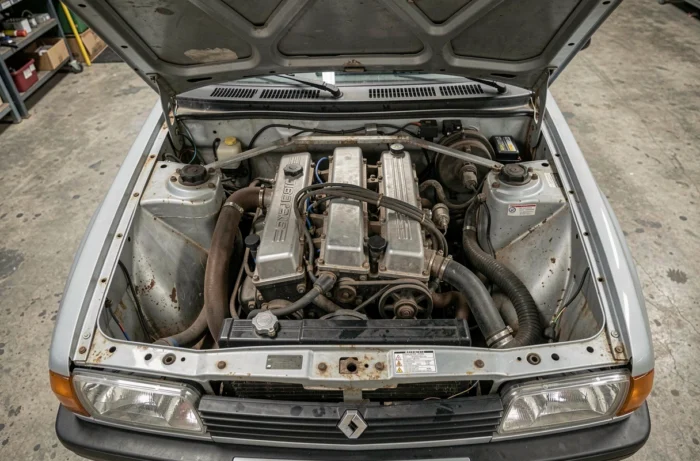
Collection value of the Renault 30: a changing market
Long considered a car of little interest to collectors, the Renault 30 is experiencing a resurgence of attention. Specialized sources from 2026 report a noticeable increase in collection values for well-preserved original examples.
This revaluation can be explained by several factors. The increasing rarity of surviving examples plays a direct role. Many Renault 30s were scrapped in the 1990s and 2000s when their market value was nearly zero.
- The TX injection versions, generally better maintained, are the most sought after
- An example with documented maintenance history trades significantly above a model without records
- The availability of PRV parts remains decent thanks to the sharing of this engine with other vehicles (Peugeot 604, Volvo 264, DeLorean DMC-12)
The sharing of the PRV block among several manufacturers facilitates maintenance. A collector can source engine parts through the Peugeot or Volvo network, which is not the case for more obscure French models from the same era.
The Renault 30 remains a technically demanding car to maintain. The cooling system and K-Jetronic injection system require regular attention. But for those interested in French industrial history, it embodies a turning point in Renault’s premium strategy, where an ambitious V8 transformed into a shared V6, laying the groundwork for unprecedented European cooperation in the automotive industry.