
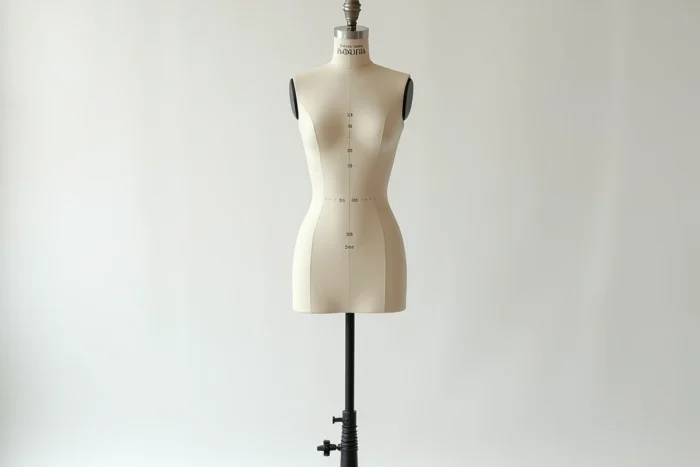
A standard mannequin, in the vocabulary of fashion agencies, refers to a profile whose body dimensions correspond to the clothing prototypes used by designers and brands. These prototypes are made in a single size, which requires mannequins to have a precise build so that the pieces fit correctly on the body.
Display mannequin and living mannequin: two distinct size references
The word “mannequin” encompasses two realities. In decoration and merchandising, it refers to a static silhouette made of resin or fiberglass, calibrated to showcase clothing in stores. In fashion, it is a person whose job is to wear and present collections.
The dimensions of a display mannequin are fixed and standardized by the manufacturer. They replicate an average morphology, often a size 36 or 38 for female models. Living mannequins, on the other hand, must fall within a range of measurements dictated by agencies and fashion houses.
This distinction matters because the selection criteria for a living mannequin are not limited to centimeters on a measuring tape. A comprehensive file on mannequin measurements on Mam’Zell Plume details, in particular, shoulder width and the waist-hip ratio, two parameters often overlooked in favor of stature alone.
Standard size and measurements in agencies: women and men
International agencies operate with reference ranges. For editorial and haute couture women’s fashion, the expected stature generally falls between 1.76 m and 1.80 m. In commercial or advertising modeling, the threshold lowers and the range widens, accepting profiles starting from 1.72 m.
For men, the standards are slightly higher. Agencies like IMG, Next, or Elite seek profiles measuring between 1.84 m and 1.91 m for fashion, with a slightly wider tolerance in advertising.
Measurements beyond height
Height alone is not enough. Casting directors and tailors check a set of measurements that determine whether a clothing prototype will fit the mannequin without major alterations:
- Chest circumference: for men, the common range is around 95 to 105 cm. For women, agencies look for a bust proportional to the waist without imposing a single number.
- Waist circumference: this is often the most discriminating criterion, as a difference of a few centimeters can prevent a prototype piece from closing. For men, the reference is around 80 to 82 cm.
- Hip circumference: it must be consistent with the waist measurement to ensure the garment’s balance, generally between 87 and 93 cm for men.
These figures pertain to editorial fashion. Commercial modeling applies more flexible criteria, as the photographed garments exist in multiple sizes and are adjusted on set with pins or clips.
French regulation and medical certificate: a criterion that has become mandatory
French legislation has introduced a direct health constraint on the profession. Since the law came into effect in 2015, any mannequin working in France must present a medical certificate attesting to their state of health, issued by an occupational physician. This measure aims to prevent issues related to excessive thinness.
Digital retouching of the silhouette in photographs for commercial use must also be indicated by the mention “retouched photograph.” This legal framework has had a concrete effect on Parisian agencies: castings now include the verification of the certificate alongside measurements.
For foreign mannequins working during Paris Fashion Weeks, the rule also applies. French agencies require the document before any booking is made, which has led some international profiles to forgo contracts due to the lack of a valid certificate.
Commercial modeling and new segments: dimensions that are expanding
Modeling is no longer limited to haute couture runways. E-commerce, digital advertising, and mainstream brand campaigns have created a demand for profiles that do not fit traditional standards.
Plus-size mannequins meet specific criteria. Rather than a single build, brands seek a proportional silhouette that corresponds to their target clientele. The senior segment is also growing: specialized agencies are recruiting profiles over fifty for targeted campaigns.
Mannequins below classic standards
Profiles measuring less than 1.72 m for women or less than 1.83 m for men find opportunities in advertising, catalog work, and social media content. Alignment with the target audience takes precedence over agency size in these contexts. A ready-to-wear brand has no interest in showcasing its clothing on a physique that its clientele does not share.
This evolution does not eliminate haute couture standards. It creates a second, parallel market where the sought-after dimensions vary according to the creative brief and distribution channel. Agencies recruiting for these segments place greater emphasis on photogenicity, energy in front of the camera, and the ability to embody a brand universe than on conformity to a measurement chart.
The profession of modeling remains structured around precise reference dimensions for haute couture and editorial fashion. French health regulations add an additional filter that other markets do not impose. For commercial modeling, selection criteria are gradually shifting from raw measurements to the coherence between the mannequin’s profile and the brand’s audience.